


You just passed the BCBA exam. Before you have time to update your LinkedIn, the job offers start coming. That is not an exaggeration; with 132,307 BCBA job postings in 2025 and only 83,586 active BCBAs in the country, there are roughly 1.6 open positions for every certified professional. So what does that seller's market mean for your BCBA starting salary? More than you might expect.
Whether you are finishing your supervised fieldwork or days away from your certification number, this guide breaks down what entry-level BCBAs actually earn in 2026, which settings and states pay the most, and how to use the historic talent shortage to negotiate a stronger first offer.
What Do Entry-Level BCBAs Actually Earn?
The short answer: it depends on where you look. BCBA salary data varies by source because "Board Certified Behavior Analyst" is not its own Bureau of Labor Statistics category. Different platforms use different methodologies, so cross-referencing is important.
Here is what the major sources report for BCBAs with zero to one year of experience:
- ZipRecruiter (April 2026): $89,075 average for entry-level BCBAs, with a range of $66,000 to $99,000
- MyABAJobs (2026): $58,000 to $68,000 for entry-level positions
- Trusted Health: $72,450 average across all experience levels, with the lowest 10% earning around $56,135
- BLS (SOC 21-1018, May 2024): $59,190 median for the broader "substance abuse, behavioral disorder, and mental health counselors" category, though BCBAs typically earn at or above the 75th percentile ($76,230) of this group
The wide range reflects real differences in geography, work setting, and employer type. A new BCBA at a small clinic in a rural market might start at $58,000, while the same credential in a metro area with high demand could command $85,000 or more. That said, the overall trend is clear: starting salaries have been climbing, and the reason is straightforward supply and demand.
Why BCBA Starting Salaries Keep Climbing
The ABA field has a workforce problem that works in your favor if you are entering it. According to the BACB's Lightcast employment demand report, employers posted 132,307 positions requesting BCBA certification in 2025. That represents a 28% increase over the prior year.
Meanwhile, the BACB reports just 83,586 active BCBAs in the United States as of April 2026. Simple math: there are roughly 1.6 job postings for every certified BCBA in the country.
But the real gap is even wider. A caseload analysis cited by industry researchers found that the field currently averages about 39 clients per BCBA, nearly five times the recommended benchmark of eight. To meet actual clinical demand, the United States would need approximately 362,500 BCBAs; that is more than four times the current supply.
The geographic picture makes the shortage even more stark. More than half of all U.S. counties have zero BCBAs practicing within their borders. Massachusetts leads the nation at 55.1 BCBAs per 100,000 residents, while large swaths of the rural South and Mountain West fall below 15 per 100,000. California alone accounts for 15% of national demand.
"Entry-level professionals rarely enter a field where employers are competing for them. In ABA, that is the reality in 2026."
What does this mean in practical terms? Employers are raising starting salaries, offering signing bonuses, and improving benefits packages to attract newly certified BCBAs. If you are about to enter the job market, you have more leverage than you probably realize.
BCBA Starting Salary by Work Setting
Your work setting is one of the biggest factors in your starting salary. Here is what new BCBAs can expect across the most common practice environments:
| Setting | Starting Range | Notes |
|---|---|---|
| Clinic-Based | $65,000 - $85,000 | Most structured career ladders; productivity bonuses common |
| School-Based | $60,000 - $80,000 | Academic calendar; possible student loan forgiveness in public schools |
| Home-Based | $60,000 - $78,000 | Flexible scheduling; mileage reimbursement; often higher effective hourly rates |
| Hospital / Medical | $70,000 - $90,000 | Specialty programs (feeding, severe behavior) at the higher end |
| Telehealth | $65,000 - $85,000 | Eliminates geographic salary constraints; growing rapidly |
| Private Practice | $95,000 - $150,000+ | Highest ceiling but typically not a first-job path; business overhead applies |
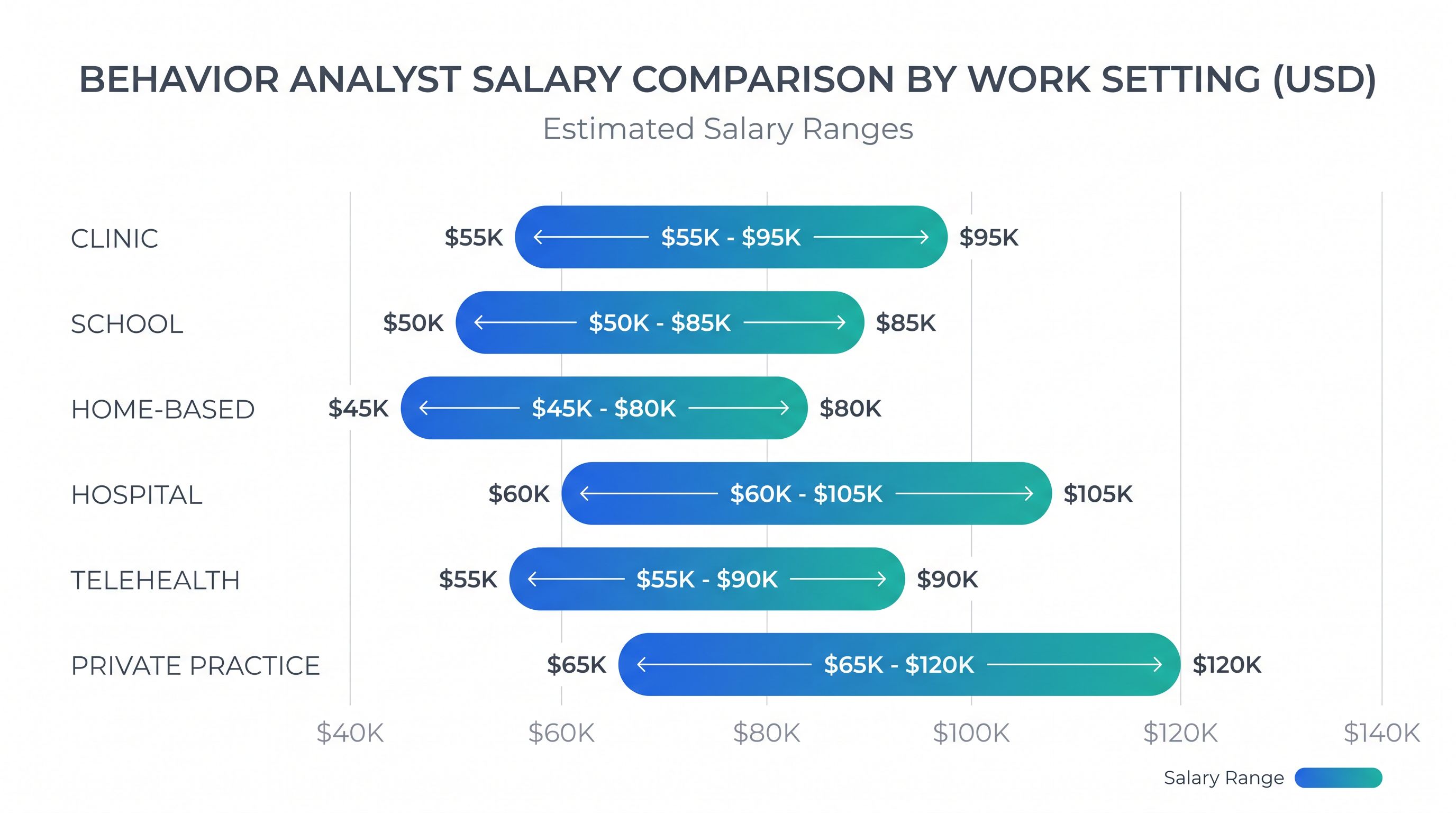
A few things stand out. Clinic-based positions offer the most predictable combination of competitive pay, benefits, and professional support for a new BCBA. Hospital and medical settings pay more on average, but those positions are also harder to land without prior experience. Telehealth roles are worth watching closely; they are growing fast and can offer metro-level salaries regardless of where you live.
Private practice is listed for context, but most BCBAs build several years of clinical experience before going independent. If you are curious about that path, our guide on how to start an ABA therapy practice covers the details.
Where New BCBAs Earn the Most
Geography plays a significant role in your BCBA starting salary. Here are the top-paying states based on average BCBA compensation data from Trusted Health and the Bureau of Labor Statistics:
- California: $90,556 average (also 15% of national demand)
- New York: $84,615 average
- Massachusetts: $81,210 average (highest BCBA density at 55.1 per 100K residents)
- Washington, D.C.: $80,631 average
- Alaska: $79,220 median (BLS data)
However, raw salary numbers only tell part of the story. A $70,000 offer in Texas or North Carolina may provide more purchasing power than $90,000 in the Bay Area or Manhattan. Cost of living adjustments matter, especially when you are evaluating your first offer.
For a detailed breakdown of compensation in all 50 states, see our BCBA salary by state guide.
How to Maximize Your First BCBA Starting Salary
With demand this high, you have more negotiation power than you think. Here are practical steps to make the most of it:
1. Negotiate from strength. With 1.6 job postings per active BCBA, you are not begging for a position. Research the market rate for your target setting and location, then ask for the upper range. Most employers expect negotiation and build room into their initial offers.
2. Evaluate the full compensation package. Base salary is important, but it is not everything. Ask about signing bonuses (increasingly common at $2,000 to $10,000), CEU reimbursement, supervision stipends if you plan to supervise RBTs, student loan assistance, and health benefits. A $65,000 salary with a $5,000 signing bonus, full CEU coverage, and strong benefits may outperform a $72,000 offer with bare-bones perks.
3. Consider underserved markets. Areas with low BCBA density are offering premium compensation to attract talent. Rural communities, smaller cities, and states in the South and Mountain West may offer starting salaries that rival coastal metros once you factor in cost of living.
4. Pursue in-demand specializations. BCBAs with additional training in feeding disorders, severe behavior, organizational behavior management (OBM), or gerontology can command 10% to 20% higher starting offers. Even as a new BCBA, coursework or practicum hours in these areas can differentiate you.
5. Let employers come to you. Traditional job searching puts you in a reactive position. Reverse job marketplaces flip that dynamic; you create an anonymous profile highlighting your credentials, and employers send interview requests to you. This naturally drives competition and better offers.
For a deeper dive into negotiation tactics specific to BCBAs, see our BCBA salary negotiation guide.
The Earning Trajectory: Where Your Salary Goes from Here
Starting salary matters, but the trajectory matters more. Here is what BCBAs typically earn as they advance:
- Entry-level (0-1 years): $58,000 - $89,000
- Mid-career (3-5 years): $78,000 - $95,000
- Senior / Clinical Director (5-10 years): $90,000 - $130,000
- Private practice owner: $150,000 - $300,000+
The jump from entry-level to mid-career typically happens within two to three years, especially in settings with structured career ladders. BCBAs who take on supervisory responsibilities, develop specializations, or move into clinical director roles see the steepest salary growth. For a comprehensive look at the career trajectory, see our guide on BCBA career paths in 2026.
Your BCBA Is New; Your Market Value Is Not
The numbers are clear: entry-level BCBAs in 2026 are entering one of the strongest job markets in healthcare. With 132,307 open positions competing for roughly 83,586 certified professionals, employers are raising salaries, expanding benefits, and offering signing bonuses to attract talent. Starting salaries ranging from $58,000 to $89,000 are just the beginning of a career with significant upward mobility.
The workforce shortage is not closing anytime soon. If anything, the gap between demand and supply continues to widen, which means the leverage new BCBAs hold today is likely to grow.
See What Employers Are Offering New BCBAs
Create a free, anonymous profile on CertifyndABA and let employers compete for your credentials. See real salary ranges and benefits before you apply.
Create Your Free Profile