


If your child is on an ABA waitlist, the honest answer to "how long?" is usually three to six months, and longer in some states. A 2023 survey of California caregivers found an average wait of three months for ABA therapy, with one family in three waiting six months or more. In Michigan, nearly three out of four families were waitlisted, for about 5.5 months on average. Those waits are not random. They are the family-side view of a workforce gap that we can measure, state by state, in the Behavior Analyst Certification Board (BACB) registry.
This guide covers how long ABA waitlists run in 2026, why they exist, why your state matters so much, and what families can do while they wait. It ends with what the same numbers mean for behavior analysts, because a waitlist is also a hiring signal.
The short version
- Typical ABA waitlists run about 3 to 6 months; a third of California families waited 6 months or more.
- A diagnostic evaluation often comes first, and 59% of surveyed autism centers quoted a wait of 4 months or longer for one.
- BCBA job postings rose 28% in 2025, while the number of US BCBAs rose 10.7%.
- Massachusetts has 7 times as many BCBAs per resident as Wyoming, so where you live shapes how long you wait.
How long is the ABA waitlist in 2026?
There is no national registry of ABA waitlists, so the best evidence comes from caregiver surveys. Two stand out.
The University of California, San Francisco surveyed 646 California caregivers in late 2023 for the Lucile Packard Foundation. Among families whose child had started ABA in the past year, the average wait was three months. The spread was wide: 12% started within a month, 28% waited one to two months, 27% waited three to five months, and 33% waited six months or longer (UCSF, 2024).
In Michigan, researchers at Eastern Michigan University and the Autism Alliance of Michigan found that nearly 75% of surveyed families had been placed on a waitlist, and the average wait was about 5.5 months (Briggs and Peterson, 2022). Two details from that study are worth knowing. Families in cities tended to wait longer, and joining more waitlists did not significantly shorten the wait.
Provider-side data tells a slightly better story. In a RethinkFirst survey reported by Behavioral Health Business (2025), 62% of BCBAs said they could start a new client within four weeks, while 15% reported waits of six months or more. The gap between the two views is real: a family often calls several providers who are full before reaching one with an opening.
The wait before the waitlist: diagnosis
Most insurance plans require an autism diagnosis before they authorize ABA, so many families face two queues. A 2023 survey of 100 US autism centers found that only 14% could evaluate a child within four weeks. Another 25% quoted one to three months, 31% quoted four to six months, 15% quoted seven to eleven months, and 13% quoted more than a year (Kraft et al., 2023). The centers named workforce shortage as their top barrier, at 69%.
Why ABA waitlists exist: the clinician math
An ABA program needs a Board Certified Behavior Analyst (BCBA) to assess the child, write the treatment plan and supervise it, plus Registered Behavior Technicians (RBTs) to deliver most of the direct hours. When either role runs short, intake stops.
The supply has grown fast. The BACB registry counted 74,927 US BCBAs and BCBA-Ds in December 2025, and 82,704 in November 2026. That is up from 29,309 in December 2018. RBTs grew even faster, to 275,824 in November 2026 (BACB, 2026).
Demand grew faster still. In the BACB's report on Lightcast job-posting data, US employers posted 132,307 BCBA or BCBA-D jobs in 2025, a 28% increase over 2024 (BACB, 2026). Over the same year, the number of US BCBAs grew 10.7%. That works out to about 1.8 postings in 2025 for every BCBA certified at the end of the year. Postings are a yearly flow and certificants are a count at one moment, so the ratio does not mean every BCBA has two open jobs. It does show demand pulling ahead of supply.
The direct-care layer is under even more strain. CentralReach's 2025 market report, cited by Behavioral Health Business (2026), put frontline turnover at 77% to 90% depending on organization size. Every technician who leaves takes a schedule of client hours with them, and those clients move back toward the waitlist until a replacement is hired and trained. Providers interviewed by Behavioral Health Business (2025) called technician hiring the top constraint on wait times.
"Because of the staffing, we are pulling out of ABA services." An Easterseals PORT Health spokesperson, on closing a Wilmington, North Carolina ABA program in 2026 (WECT)
Your state shapes the ABA waitlist
The national averages hide a very uneven map. We divided each state's November 2026 BCBA and BCBA-D count from the BACB registry by its 2025 Census population. The US average is 24.2 behavior analysts per 100,000 residents. Massachusetts has 57.7. Wyoming has 8.3, Mississippi 8.9, Montana 9.3 and Oklahoma 10.7.
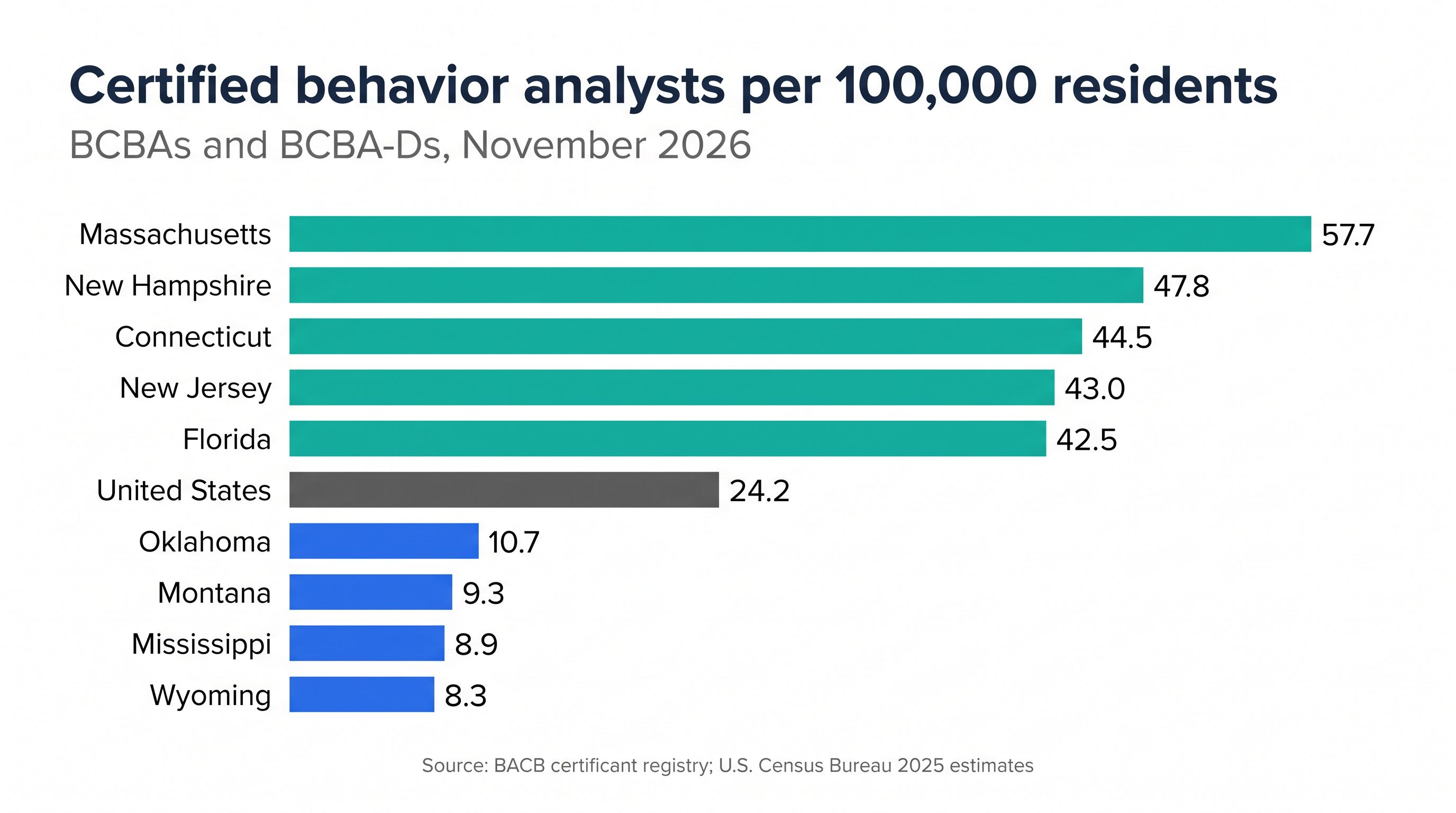
Density is not the only factor. Some low-density states have a smaller share of residents who qualify for coverage, and a state's RBT workforce can stretch each BCBA further. Oklahoma, for example, has 7.4 RBTs per BCBA, more than double the US ratio of 3.3. Still, where there is one behavior analyst for every 10,000 or more residents, families have fewer providers to call.
Hiring pressure also varies. Comparing 2025 postings with each state's current BCBA count, Maryland had about 3.4 postings per BCBA, Kansas 2.9, North Carolina 2.9 and Georgia 2.6, against a national figure of about 1.6. Those are the states where employers compete hardest for each clinician, and where intake is most likely to stall when one leaves.
Medicaid rates can lengthen the line
Reimbursement decides whether a provider can afford to hire. In 2025, Nebraska set new Medicaid rates that cut the $36.11 it paid per 15 minutes of ABA to $18.70 for treatment by an RBT and $22.72 for treatment by a BCBA, decreases of 48% and 37%. The state had 317 BCBAs against an estimated need of 700 to 800, and one parent was quoted a 15-month wait that stretched to two years (Nebraska Public Media, 2025). North Carolina proposed a 10% ABA rate cut in 2025 before the governor canceled it in December (KFF Health News, 2025). In Colorado, at least 13 ABA companies running about 35 clinics closed or left the state between 2021 and early 2024, as Medicaid rates rose 6.2% while costs rose far faster (Denver Post, 2024).
Insurance authorization adds its own delay. In a 2024 Nevada state survey, providers named lengthy prior authorization processes and denials of direct ABA therapy among their main barriers to serving families (Nevada ADSD, 2024).
How to shorten an ABA waitlist
No step guarantees a faster start, but these help families make use of the wait.
- Request a free early intervention or school evaluation now. The CDC notes that you do not need a doctor's referral or a diagnosis to get a free evaluation. Children under 3 can get early intervention services, and public schools serve children from age 3 (CDC, 2025).
- Start other therapies while you wait. The Marcus Autism Center advises families not to wait for a diagnosis to begin speech, occupational or behavioral therapy, and points to caregiver workshops and at-home strategies.
- Join more than one list, but expect a hedge, not a shortcut. The Michigan survey found that more waitlists did not significantly shorten the wait. They do protect you if one provider loses staff.
- Ask each provider what is causing its wait. A clinic waiting on a BCBA hire may open sooner than one with a long intake queue. Ask whether it has openings at less popular times of day or in a different setting, such as in-home or school-based services.
- Check your insurance authorization early. If your plan requires prior authorization, start the paperwork as soon as you choose a provider so the approval is ready when a spot opens.
What ABA waitlists mean for BCBAs
For behavior analysts, the same data describes a job market with real leverage. A clinic with a waitlist has families ready to start and revenue it cannot collect until it hires. That is why postings grew more than twice as fast as the certified workforce in 2025.
Use that leverage carefully. A long waitlist can also signal a provider that cannot keep staff, so ask direct questions before you accept an offer: How many clients would I supervise? How many RBTs support each case? Why did the last BCBA in this role leave? Our guides to the BCBA shortage and BCBA demand cover the market in more depth, and BCBA salary by state shows what that demand pays. If you are open to relocating, low-density states such as Oklahoma have some of the widest gaps.
Frequently asked questions
How long is the typical ABA waitlist?
Most surveyed families wait about three to six months. In California the average was three months, with a third of families waiting six months or longer (UCSF, 2024). In Michigan, nearly 75% of families were waitlisted, for about 5.5 months on average (Briggs and Peterson, 2022).
Why is there a waitlist for ABA therapy?
Demand for behavior analysts is growing faster than the workforce. BCBA job postings rose 28% in 2025 while the number of US BCBAs rose 10.7%, and frontline technician turnover is high. Medicaid rates and insurance authorization delays add to the wait in many states.
Do I need an autism diagnosis to get off the ABA waitlist?
Most insurers require a diagnosis to authorize ABA, so it helps to schedule an evaluation early. You do not need a diagnosis to request a free early intervention or school evaluation, and those services can start while you wait (CDC, 2025).
Which states have the longest ABA waitlists?
No state publishes official waitlist times. States with few behavior analysts per resident, such as Wyoming, Mississippi, Montana and Oklahoma, have fewer providers to choose from, and states that cut Medicaid ABA rates, such as Nebraska in 2025, have reported long waits.
The bottom line on ABA waitlists
An ABA waitlist is not a single line. It is a diagnosis queue, an authorization queue and a staffing queue stacked together, and the staffing queue depends heavily on where you live. Families can shorten parts of it by starting early intervention, therapy and paperwork now. The longer fix is more behavior analysts and technicians in the places that have the fewest.
Work where families are waiting for you
Connect with employers committed to best practices. Create a free, anonymous profile, see pay before you share your name, and let clinics with open caseloads reach out to you.
Create Your Free Profile