


The best BCBA study guide is free, and the BACB publishes it: the BCBA Test Content Outline (6th ed.). It lists all 104 tasks the exam can test and how many of the 175 scored questions come from each of its nine domains. Everything else, from a $175 study manual to a $779 module course, is a way of practicing those tasks. This guide turns the outline into a plan: where the questions concentrate, what to master in each domain, a 12-week schedule that fits around a full-time job, and what the main study materials actually cost in October 2026.
What a BCBA study guide has to cover in 2026
Since January 1, 2025, the BCBA exam has been built from the 6th edition Test Content Outline (TCO). The BACB describes the outline as the knowledge and skills its most recent job task analysis identified as important for entry-level BCBAs. As of its January 2026 transition guidance, the BACB says there are no upcoming changes to the exam or the outline, so a BCBA study guide built on the 6th edition is current, and the 2027 eligibility changes covered in our guide to becoming a BCBA do not change the exam itself.
The exam format is fixed in the BCBA Handbook (updated 06/2026):
- 185 questions in 4 hours. That time also covers the terms, tutorial and load screens. 175 questions are scored and 10 are unscored pilot questions, and the BACB does not tell you which ones are which.
- Four answer options, one correct. All questions carry equal weight.
- Pass or fail, on overall performance. You do not need to pass each domain separately, and the passing score is set by subject matter experts using the modified Angoff method.
- No notes, textbooks, scratch paper or calculators. The test center gives you a dry-erase board instead. Anything you need, including interobserver agreement formulas, has to be in your head when you walk in.
One more line from the handbook matters when you shop for materials: "The BACB cannot endorse specific study guides or other preparation materials." No vendor is official. Judge each one by how closely it maps to the outline and how many realistic practice questions it gives you.
Where the questions concentrate
A common approach is to allocate study time by domain size. A sharper way is to look at how many questions each task carries. Concepts and Principles (domain B) has the most tasks, 24, but only 24 questions, about one per task. Behavior Assessment (F) has just 8 tasks and 23 questions, close to three per task. If questions are spread evenly within a domain (the BACB does not say they are), each assessment task is worth almost three times as many points as each concepts task.
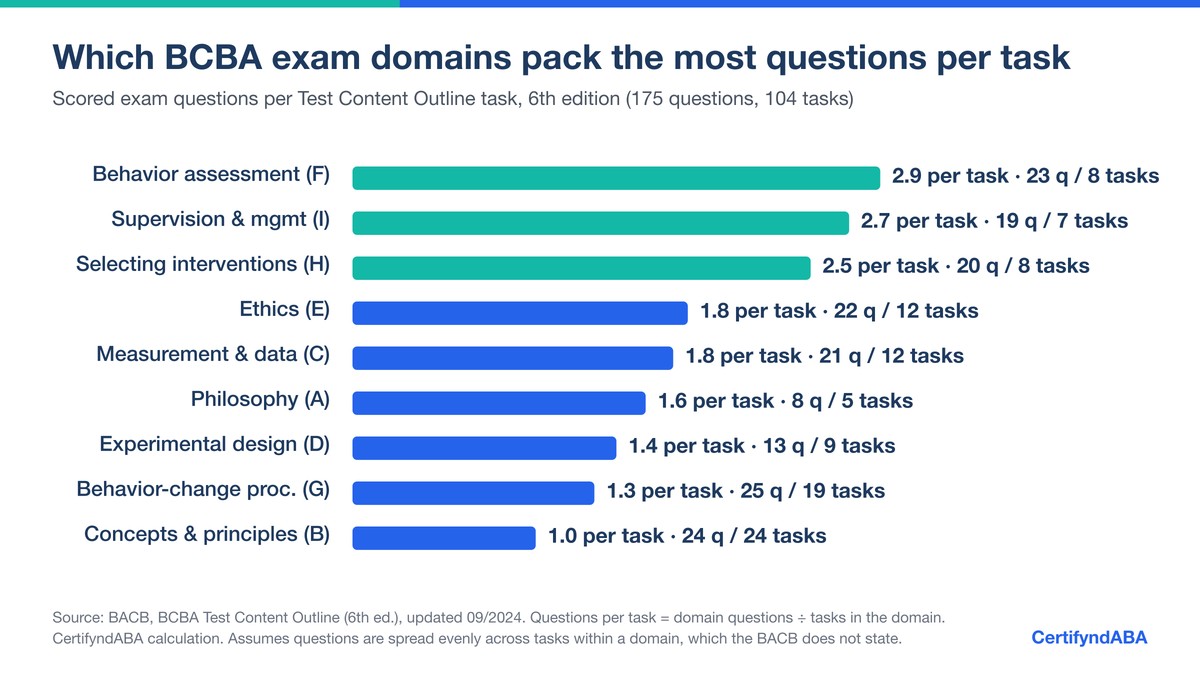
That does not mean you can skim domain B. The applied domains (F, G, H, I) are written as scenarios, and you cannot pick the right functional analysis condition or the right differential reinforcement procedure without the principles underneath. The practical lesson is about where to spend your second pass: the eight assessment tasks, eight intervention-selection tasks and seven supervision tasks deserve deep, scenario-level practice, because each one shows up repeatedly.
| Domain | Questions | Tasks | Questions per task | Hours in a 120-hour plan |
|---|---|---|---|---|
| A. Behaviorism and Philosophical Foundations | 8 | 5 | 1.6 | 5 |
| B. Concepts and Principles | 24 | 24 | 1.0 | 15 |
| C. Measurement, Data Display, and Interpretation | 21 | 12 | 1.8 | 12 |
| D. Experimental Design | 13 | 9 | 1.4 | 8 |
| E. Ethical and Professional Issues | 22 | 12 | 1.8 | 10 |
| F. Behavior Assessment | 23 | 8 | 2.9 | 14 |
| G. Behavior-Change Procedures | 25 | 19 | 1.3 | 16 |
| H. Selecting and Implementing Interventions | 20 | 8 | 2.5 | 10 |
| I. Personnel Supervision and Management | 19 | 7 | 2.7 | 10 |
| Total | 175 | 104 | 1.7 | 100 + 20 for mock exams |
Source: BACB, BCBA Test Content Outline (6th ed.), updated 09/2024. The hours column is an example, not a BACB recommendation: 100 content hours split roughly in proportion to each domain's question count, with B and G nudged up because the scenario domains build on them, plus 20 hours for two timed mock exams and their review. The 12-week plan below uses the same numbers.
A domain-by-domain BCBA study guide
Use the TCO task codes as your checklist. For each domain below you will find what the tasks ask for and the distinctions that most often trip candidates up. Each task in the outline starts with a verb, and the verb tells you the level of skill: "identify" tasks ask you to recognize an example, while "design and evaluate" tasks ask you to choose or critique a procedure in a scenario.
A. Behaviorism and Philosophical Foundations (8 questions, 5 tasks)
Know the goals of the science (description, prediction, control), the philosophical assumptions (selectionism, determinism, empiricism, parsimony, pragmatism), radical behaviorism, and the seven dimensions of applied behavior analysis from Baer, Wolf and Risley (1968). The classic trap is task A.4: telling apart behaviorism, the experimental analysis of behavior, applied behavior analysis and professional practice guided by the science.
B. Concepts and Principles (24 questions, 24 tasks)
Most tasks here (15 of 24) begin with "identify and distinguish," so study in pairs: positive versus negative reinforcement and punishment, operant versus respondent extinction, stimulus versus response generalization, motivating operations versus stimulus control (B.17), rule-governed versus contingency-shaped behavior, and the verbal operants (mand, tact, echoic, intraverbal, textual, transcription, and the autoclitic). Write each pair as a two-column flashcard and drill until you can classify a new example in seconds. The later tasks on behavioral momentum, the matching law and emergent relations (B.21 to B.23) are easy to skip and worth one solid session each.
C. Measurement, Data Display, and Interpretation (21 questions, 12 tasks)
Memorize the measures and when each fits the critical dimension of the behavior: count, rate, duration, latency, interresponse time, and the discontinuous methods (whole interval, partial interval, momentary time sampling). Know which way each discontinuous method tends to err: whole interval tends to underestimate and partial interval tends to overestimate. Practice reading graphs for level, trend and variability, and add procedural integrity measurement (C.12), a task new to the 6th edition (the 5th edition mentioned treatment integrity only under monitoring client progress).
D. Experimental Design (13 questions, 9 tasks)
Be able to name a design from a graph and say what it can and cannot show: reversal, multiple baseline (across behaviors, settings or people), multielement and changing criterion. Know the threats to internal validity, the logic of prediction, verification and replication, and why you would run a comparative, component or parametric analysis (D.8).
E. Ethical and Professional Issues (22 questions, 12 tasks)
Read the Ethics Code for Behavior Analysts itself, not a summary, at least twice. Scenario questions hinge on details such as multiple relationships and how to mitigate them when they cannot be avoided (E.7), confidentiality and disclosure (E.4), public statements and social media (E.5), and how to transition clients or supervisees when services end (E.6). Four tasks (E.8 to E.11) cover interpersonal skills, cultural humility, culturally responsive service and personal bias; expect scenario items on them rather than recall.
F. Behavior Assessment (23 questions, 8 tasks)
This is the densest domain on the exam. Know indirect, descriptive and experimental assessment, and be able to design and interpret a functional analysis: the test and control conditions, what each outcome pattern suggests, and when a different format makes sense. Do the same for preference assessments (single stimulus, paired stimulus, multiple stimulus with and without replacement, free operant). Two tasks (F.7 and F.8) ask you to interpret results to decide whether to refer out and how to prioritize goals that are socially significant and client-informed.
G. Behavior-Change Procedures (25 questions, 19 tasks)
The largest list of procedures: differential reinforcement (DRA, DRO, DRL, DRH) with and without extinction, time-based schedules, token economies, prompting and prompt fading (most-to-least, least-to-most, prompt delay, stimulus fading), shaping, chaining, group contingencies, generalization and maintenance, and punishment procedures. For each, know when to pick it, what emotional and elicited effects it can produce (G.18), and how to plan for them (H.4).
H. Selecting and Implementing Interventions (20 questions, 8 tasks)
These questions put you in the seat of the treating BCBA: write a measurable goal, pick an intervention that fits the assessment results, client preferences and the setting, choose a socially valid replacement behavior, plan for relapse, and use integrity and outcome data to decide whether to change course (H.6 and H.7). Practice by explaining aloud why the second-best answer is wrong.
I. Personnel Supervision and Management (19 questions, 7 tasks)
Seven tasks carry 19 questions, so this domain repays focused study. Know the benefits of behavior-analytic supervision, how to set up a supervisory relationship and contract, equity in supervision, performance management procedures (modeling, practice, feedback, task clarification, response effort), and how to use a function-based approach such as performance diagnostics to fix a staff performance problem (I.6).
How to study for the BCBA exam: a 12-week BCBA study guide plan
Many candidates study while working, often in a BCBA-in-training role. The plan below assumes about 10 hours a week, or 120 hours in total, and follows the hours column in the table above. If you have more time, compress it; if you have less, stretch each block rather than cutting the mock exams.
| Weeks | Focus | What to do |
|---|---|---|
| 1 to 2 | Baseline, A and B (20 hours) | Read the TCO and handbook. Take a short diagnostic quiz across all nine domains, such as our 21 free BCBA exam questions, and record your score by domain. Then build two-column flashcards for every "distinguish" task and drill them daily for 10 to 15 minutes. |
| 3 to 4 | C and D (20 hours) | Measurement and IOA formulas, graph reading, design identification. Keep drilling A and B cards. |
| 5 to 7 | F and G (30 hours) | Functional analysis and preference assessment scenarios; procedures and their side effects. End each session with 20 practice questions. |
| 8 to 10 | E, H and I (30 hours) | A full read of the Ethics Code with scenario questions, then intervention selection and supervision. Keep mixing in earlier domains. |
| 11 | Mock exam 1 (10 hours) | A full 185-question timed mock in one 4-hour sitting. Spend at least as long reviewing every miss and every lucky guess. |
| 12 | Mock exam 2 and taper (10 hours) | Early in the week, a second full mock from a different source and a restudy of your two lowest domains. In the last days, short mixed quizzes only. Confirm your Pearson VUE appointment and ID, and sleep. |
Why the plan leans on practice questions
Learning research is unusually consistent on this point. A major review of ten common study techniques rated practice testing and distributed practice (spreading study over time) as the two highest-utility methods, and rated rereading, highlighting and summarizing as low utility (Dunlosky and colleagues, Psychological Science in the Public Interest, 2013). A 2021 meta-analysis of 222 classroom studies found that quizzing raised achievement by a medium amount, an effect size of g = 0.499 (Yang and colleagues, Psychological Bulletin). That is why the plan above has you answer questions in every session and revisit earlier domains with flashcards instead of finishing one domain and moving on for good.
Behavior analysts have their own version of this idea. SAFMEDS (Say All Fast Minute Every Day Shuffled), a precision teaching flashcard method, has you say answers aloud against a one-minute timer and chart your correct and incorrect rate each day. In an undergraduate behavior principles course, daily timed, typed practice on technical term definitions (a SAFMEDS variant) was associated with better fluency and longer-term retention of the terms (Lovitz, Cihon and Eshleman, Behavior Analysis in Practice, 2021). The evidence is not settled: a 2018 review concluded that much more research is needed on SAFMEDS procedures and their benefit over traditional instruction (Quigley and colleagues, Perspectives on Behavior Science), and we found no published study that tested SAFMEDS as BCBA exam prep. Treat it as a good way to drill the domain B vocabulary, not as a complete study method.
BCBA study materials compared
You do not need everything below to build your own BCBA study guide. A sound kit is the free BACB documents, one core text or manual, one large question bank and two full-length mock exams from different providers. Prices were checked on each vendor's own site on October 5 and 6, 2026; confirm before you buy.
| Resource | Type | Price | Notes |
|---|---|---|---|
| BACB TCO, BCBA Handbook, Ethics Code | Official documents | Free | The outline is your checklist; the handbook includes a few retired sample questions. |
| Cooper, Heron and Heward, Applied Behavior Analysis (3rd ed.) | Textbook | $64.98 eText (6 months); $138.66 hardcover at Pearson | The standard reference most programs teach from. Use it to look things up, not to reread cover to cover. |
| Pass the Big ABA Exam Study Manual (6th ed. V2) | Study manual | $175 | 500+ pages written for the 6th edition outline, about 300 review questions. Free glossary and IOA quiz on its site. |
| BDS CBA Learning Module Series (TCO6) | Self-paced modules | $399 (3 months) to $779 (48 months) | 3,500+ questions in 210 module sets. Money-back guarantee with strict conditions, including completing every module to 100% in the six months before the exam and reporting a fail within 14 days. |
| TrueLearn BCBA SmartBank | Question bank | $109 (30 days) to $179 (365 days) | 2,000+ questions with spaced-repetition flashcards. Its guarantee is a free renewal, not a refund. |
| ABA Exam Review (behavioranalyststudy.com) | Mock exams and guide | $115 for 8 exams; $70 guide; $140 combo | 1,480 questions across 8 exams (the vendor describes three as full-length 6th edition mocks), with free video explanations. |
| ABA Technologies BOOST | Mocks, question bank, SAFMEDS cards | $75 per mock; $225 Pro Builder; $89 for 449 SAFMEDS cards | Mock A and B are 175 questions, one attempt each. Free 10-question sample. |
| Behavior School | Free mock and diagnostic | Free (account needed for the full mock) | One full 185-question timed mock aligned to the 6th edition, plus a 9-question diagnostic. |
Two cautions. First, some vendors still call the 6th edition a "Task List"; the 5th edition was the Task List, and the 6th edition is the Test Content Outline. If a product's domain names or task codes do not match the 2025 outline, it may be built on the old one. Second, vendor pass rates, such as BDS's reported 98.5% first-time pass rate for customers who complete every module, describe people who finished the whole course, not everyone who bought it. Compare them against the BACB's own figure: 51% of first-time candidates passed in 2025. User-made flashcard decks on Quizlet and Brainscape are free but unvetted, so check any card that contradicts the textbook.
How hard is the BCBA exam?
Hard enough that about half of first-time candidates fail, and the first-try odds have been slipping. In 2025, 9,955 people sat for the BCBA exam for the first time and 51% passed; of 13,196 retake candidates tested, 23% passed (BACB annual data). The first-time rate has fallen every year but one since 2020, when it was 66%. Pass rates also vary widely by training program. In the BACB's 2024 university pass-rate report, among the 127 programs with at least 10 first-time candidates, the median program passed 59% of them, and the middle half of programs ranged from 46% to 74%. Peer-reviewed analyses of earlier BACB data found higher pass rates for on-campus programs and for programs accredited by the Association for Behavior Analysis International (Shepley, Allday and Shepley, Behavior Analysis in Practice, 2018), and for campus and hybrid programs compared with distance programs (Guinness and Turner, Behavior Analysis in Practice, 2022). Those are program averages, not destinies; if your program sits at the low end, budget more practice-question hours rather than fewer. For a year-by-year breakdown, see our BCBA exam pass rate analysis.
Failing is expensive in time more than money. Each retake costs a $140 retake application plus a $125 Pearson VUE appointment, you must wait 30 days between attempts, and you get at most 8 attempts within the 2-year window after your application is approved. Studying properly the first time is the cheapest plan.
What is waiting on the other side
The exam is the narrowest point between a trainee and a BCBA paycheck. Employers posted 132,307 job ads that required or preferred the BCBA or BCBA-D credential in 2025, up 28% from 2024, according to the BACB's Lightcast report. At the end of 2025 there were 74,927 BCBAs and BCBA-Ds in the United States, which works out to about 1.77 postings for every certified analyst. That ratio compares a year of postings to a headcount, and some ads are reposts or unfilled, so it is a measure of pressure, not of empty seats. Even so, the same report shows demand for BCBAs rising year after year since 2010; see our guides to BCBA starting salary and BCBA job openings for what offers look like.
Frequently asked questions
What is the best BCBA study guide?
Start with the free BCBA Test Content Outline (6th ed.) from the BACB, because it lists every task the exam covers. Pair it with one core text or manual and a large bank of practice questions. The BACB does not endorse any commercial study guide.
How long should you study for the BCBA exam?
There is no official number. A common plan for working candidates is about three months at roughly 10 hours a week, which is about 120 hours. Use a diagnostic quiz at the start to decide whether you need more time.
What is on the BCBA exam in 2026?
The exam has 185 multiple-choice questions, 175 scored and 10 unscored, drawn from nine domains in the 6th edition Test Content Outline. You get 4 hours. The BACB says there are no upcoming changes to the exam or the outline.
Which BCBA exam domain has the most questions?
Behavior-Change Procedures has the most, 25 of 175. Behavior Assessment has 23 questions across only 8 tasks, which makes it the densest domain per task.
Can you bring notes or a calculator to the BCBA exam?
No. The BCBA Handbook prohibits notes, reference materials, textbooks, scratch paper, calculators and rulers, so formulas such as interobserver agreement need to be memorized.
Is the Cooper textbook enough to pass the BCBA exam?
Usually not on its own. The Cooper, Heron and Heward textbook explains the concepts, but the exam tests applied scenarios, so most candidates add a question bank and at least one full-length timed mock exam.
The bottom line
A good BCBA study guide is the outline plus practice. Use the 6th edition TCO as a checklist, give the assessment, intervention-selection and supervision tasks extra scenario practice, answer questions instead of rereading, and sit two full timed mock exams before test day. The demand for BCBAs is not going away while you study.
Passing soon? Let employers come to you
CertifyndABA is an anonymous reverse job marketplace. Showcase your verified credential and let qualified ABA employers send you interview requests with pay ranges up front.
Create Your Free Profile