
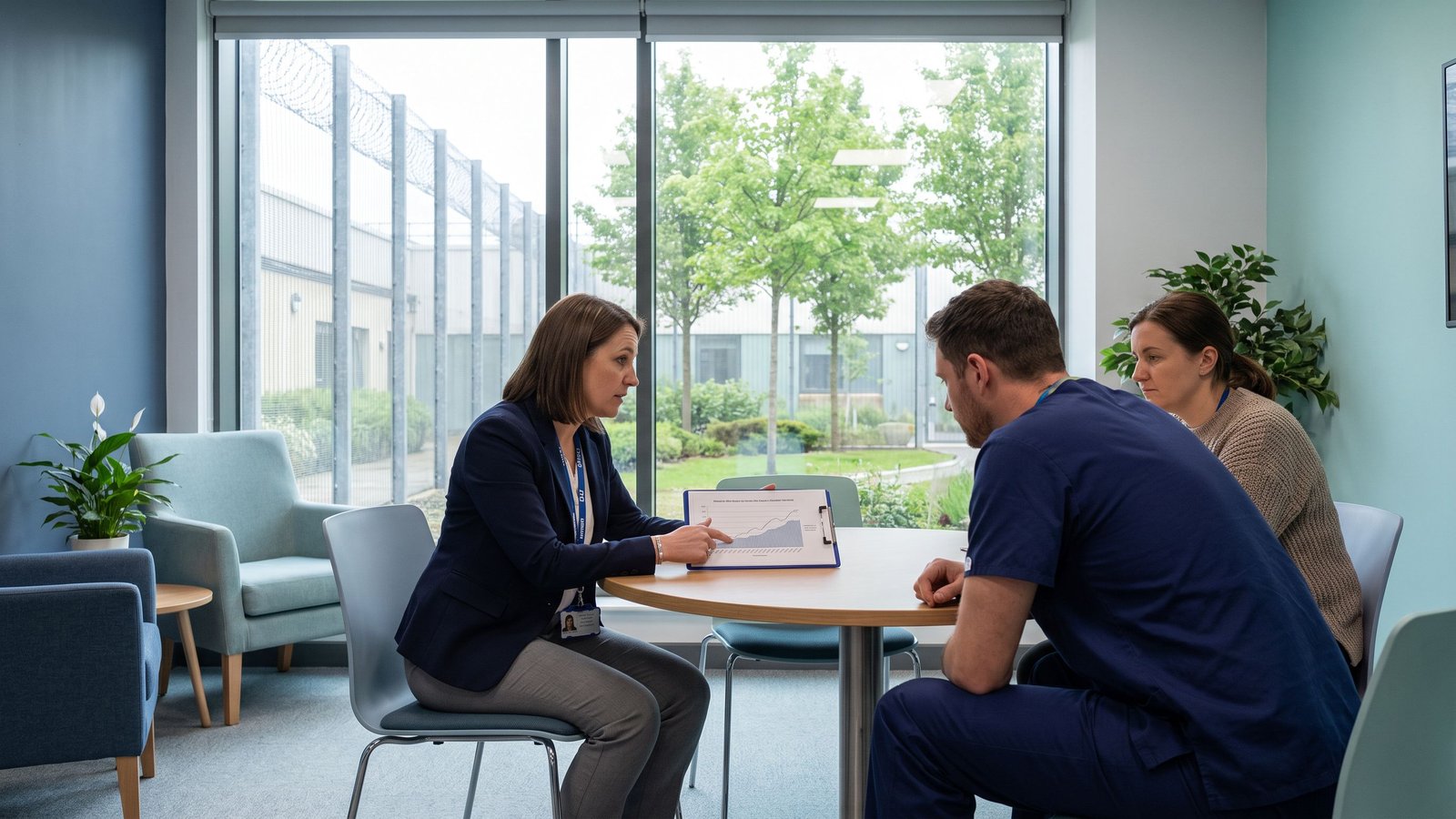

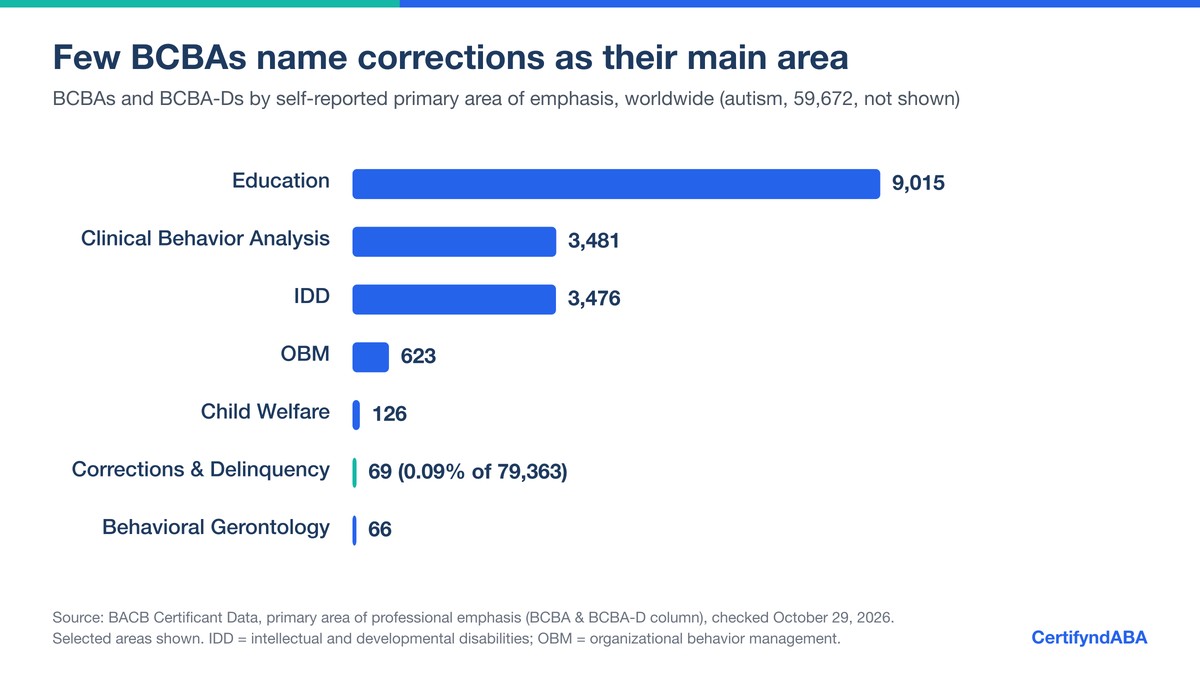
A forensic behavior analyst is a behavior analyst, usually a BCBA, who uses applied behavior analysis with people in or near the justice system: patients in forensic psychiatric hospitals, youth in juvenile justice programs, and adults with intellectual disabilities who have offense histories. It is not the FBI profiler job from television. It is also one of the rarest specialties in ABA. Only 69 of 79,363 BCBAs worldwide name Corrections & Delinquency as their main area of work (BACB certificant data, checked October 29, 2026). We searched the job boards and read the ads to show what forensic behavior analyst jobs really look like, what they pay, and how BCBAs get into them.
What is a forensic behavior analyst?
"Forensic" means connected to the courts or the law. A forensic behavior analyst does the same core work as any BCBA: functional behavior assessments, behavior intervention plans, staff training and data-based treatment decisions. The difference is the population and the setting. Clients may be court-committed, found incompetent to stand trial, on probation, in a secure unit, or living in the community under a safety plan.
The search term mixes two different careers. Google shows the FBI's Behavioral Analysis Unit next to ABA career pages, and Reddit threads ask whether a BCBA can become a criminal profiler. The short answer is no. Criminal profiling is investigative work done inside law enforcement. The FBI's Behavioral Analysis Units are part of the Bureau, and a BCBA credential is not a route into them.
| Forensic behavior analyst (ABA) | Criminal profiler (law enforcement) | |
|---|---|---|
| Goal | Reduce dangerous behavior and build skills so a person can move to a less restrictive setting | Help investigators identify and catch an unknown offender |
| Employer | State hospitals, state disability agencies, nonprofits, ABA providers | FBI and other law enforcement agencies |
| Credential | BCBA plus a state license where required | Law enforcement career; no ABA credential needed |
| Typical job title | "Behavior Analyst," "BCBA," "Behavior Clinician" | Agent or investigative analyst roles |
How rare are forensic behavior analyst jobs?
Very rare, and mostly invisible under that name. We measured it three ways.
Who does the work. The Behavior Analyst Certification Board asks certificants for their primary area of professional emphasis. Of 79,363 BCBAs and BCBA-Ds who answered, 69 chose Corrections & Delinquency (0.09%). Autism accounts for 59,672 (75%). Child welfare (126) and behavioral gerontology (66) are similar in size to corrections.
What the job boards show. On October 29, 2026, we ran the searches a BCBA would try on SimplyHired. The counts are below.
| Search | Results | What the results were |
|---|---|---|
| BCBA | 26,917 | All BCBA ads, for scale |
| "forensic behavior analyst" | 0 | No ad used the exact title |
| forensic BCBA | 18 | Mostly forensic case manager and social worker jobs |
| BCBA correctional | 57 | Mostly ads that only mention a background check |
| BCBA "juvenile justice" | 16 | Youth agencies and ABA providers that list juvenile justice as one setting |
| "criminal behavior analyst" | 2,355 | Ordinary ABA ads; the top titles were BCBA and Behavior Technician |
What the ads say. Search counts overstate the market, so we also read job descriptions. In a separate sample of 1,440 full BCBA job descriptions collected October 1, 2026, 20 used a word like "correctional," "forensic" or "offender." Only one described a forensic caseload: the Arizona State Hospital. The other 19 were mostly background-check rules, a staffing agency's client list, or civil-service probation periods.
So the honest picture is this. Forensic ABA work exists, but it is a niche of a few dozen employers, and almost none of them call the job "forensic behavior analyst." Compare that with the rest of the field: employers posted 132,307 ads that required or preferred the BCBA in 2025, for 82,198 US BCBAs and BCBA-Ds (BACB and Lightcast, 2026; BACB certificant data, October 2026). The shortage is real, but it is in autism services, not in corrections.
Where forensic behavior analysts actually work
The ads we found fall into four settings. Each one hides under a plain job title.
1. State forensic psychiatric hospitals
This is the clearest forensic BCBA job. State hospitals treat people committed by the courts, including people found incompetent to stand trial or not guilty by reason of insanity. The Arizona State Hospital posted a BCBA role for "civil and forensic adult patients" with highly aggressive or destructive behavior, at $90,000. Middle Tennessee Mental Health Institute posted a Behavior Analyst role that covers its Forensic Services Program in an involuntary inpatient setting. Texas Health and Human Services posted a Behavior Analyst I role in Terrell; it describes its state psychiatric hospitals as a hub for forensic mental health care.
2. Intellectual disability programs for people with offense histories
Some states run programs for adults with intellectual or developmental disabilities (IDD) who have offended or present a risk to others. Washington's Community Protection Program is one example. State rules describe it as voluntary services that help participants "live safely and successfully in the community" while reducing public-safety risk (WAC 388-831-0020). Dungarvin posted a Behavior Clinician II role in Tacoma for people who moved out of state hospitals, correctional facilities and diversion programs, some of whom may be in that program, at $30.00 to $33.45 an hour.
3. Juvenile justice and youth programs
Nonprofits that serve child welfare and juvenile justice clients hire behavior analysts and behavior consultants. CONCERN in Pennsylvania posted a Behavior Consultant role at $32 to $40 an hour. Adapt & Transform Behavior in Tampa listed juvenile justice programs among its BCBA settings, at $50 to $60 an hour.
4. Secure state units (the adjacent path)
Many state jobs are not forensic, but they build the same skills. Colorado's Pueblo Regional Center hires BCBAs for a "safe, secure and therapeutic setting" for people with IDD and mental illness. The State of Utah posted a BCBA role at $68,931 to $103,376 with no billable hours. Experience in units like these is the usual stepping stone to forensic work.
Forensic behavior analyst salary
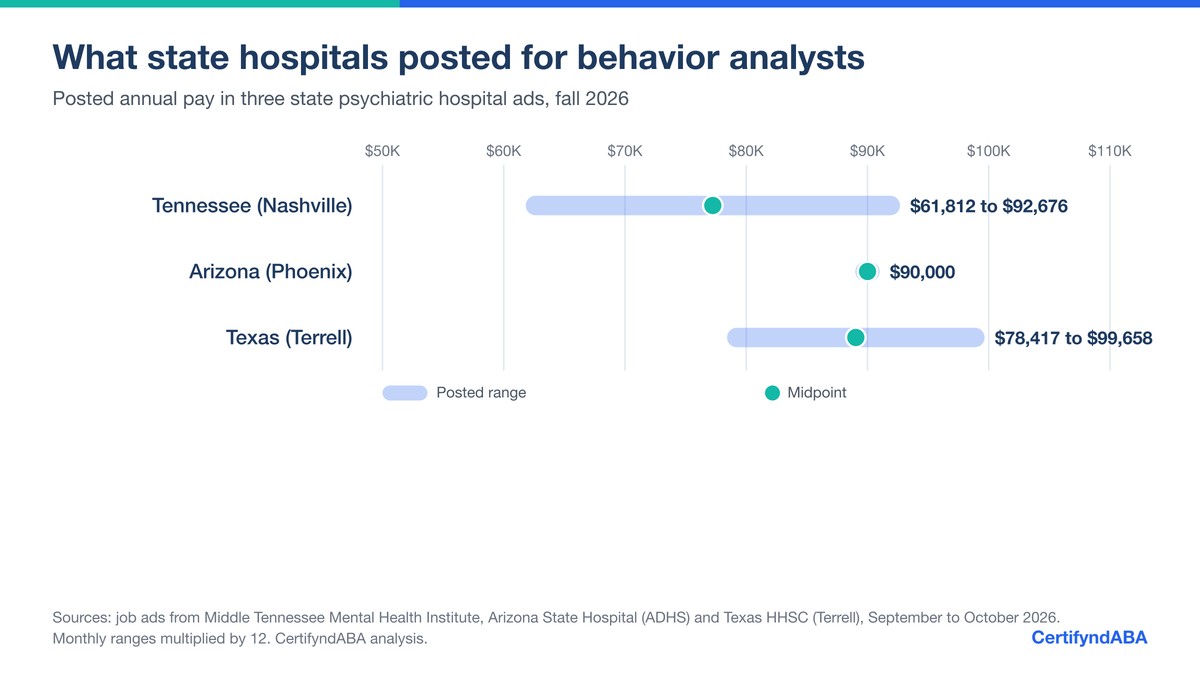
Forensic behavior analyst salary data is thin because so few ads exist. The state hospital ads we found posted annual pay of about $62,000 to $100,000.
| Employer and setting | Posted pay |
|---|---|
| Arizona State Hospital, civil and forensic patients (Phoenix) | $90,000 a year |
| Middle Tennessee Mental Health Institute, incl. Forensic Services Program (Nashville) | $5,151 to $7,723 a month |
| Texas HHSC state hospital system (Terrell) | $6,534.79 to $8,304.83 a month |
| Adapt & Transform Behavior, incl. juvenile justice programs (Tampa) | $50 to $60 an hour |
| CONCERN, child welfare and juvenile justice nonprofit (Wilkes-Barre, PA) | $32 to $40 an hour |
| Dungarvin, community IDD program incl. people leaving corrections (Tacoma) | $30.00 to $33.45 an hour |
Two patterns stand out. First, state hospital pay sits close to typical BCBA pay rather than above it; see our BCBA salary guide for the wider market. State jobs often add a pension, a set schedule and no billable-hour quota, which some BCBAs value more than a higher rate. Second, several community roles pay by the hour and some do not require the BCBA at all, so read the qualifications line. Treat these six ads as examples, not a salary survey.
What forensic behavior analysts do day to day
The job ads describe work that any BCBA who has handled severe behavior will recognize:
- Functional behavior assessments for aggression, self-injury and property destruction; the Arizona ad names "danger to self" and "danger to others" behaviors
- Behavior intervention plans that nursing and direct-care staff can carry out on every shift
- Staff training, often hospital-wide, plus crisis and de-escalation support
- Work on an interdisciplinary team with psychiatrists, psychologists, social workers and nurses
- Discharge planning toward the least restrictive setting, which is the measure of success
- Supervision of BCBA practicum students in some state hospitals
Know the scope limits. Forensic evaluations for the courts, such as competency or risk assessments, are usually done by licensed forensic psychologists. One ad we found offered a contract forensic psychologist $1,000 to $1,600 a day for juvenile court evaluations, and the "forensic" title in the Oklahoma Forensic Center ads went to licensed behavioral health professionals, not behavior analysts. Sex-offense-specific treatment can also require a separate credential; Washington's DDA policy has limited that treatment to certified sex offender treatment providers. A BCBA's role is the behavior plan and the systems around it.
How to become a forensic behavior analyst
There is no separate forensic credential from the BACB. The path is the BCBA plus the right experience.
- Earn the BCBA. You need a qualifying graduate degree, supervised fieldwork and a passing exam score. Our guide to how to become a BCBA covers each step.
- Get licensed in your state. Most states license behavior analysts, and state agencies check. See our licensed behavior analyst guide.
- Build severe-behavior experience. Adults with IDD, psychiatric inpatient units, residential treatment and crisis teams are the feeder settings. Our article on BCBA hospital jobs lists where those roles are.
- Do fieldwork in a state facility if you can. Some state hospitals supervise BCBA practicum students, which gives you the setting and the references.
- Join the professional network. ABAI's Forensic Behavior Analysis Special Interest Group reported 3,213 members in its latest update; its mission is to give criminal justice fields access to evidence-based behavior analytic resources aimed at reducing crime and delinquency (ABAI, 2026).
How to find forensic behavior analyst jobs
Searching "forensic behavior analyst" returns almost nothing useful. These searches work better:
- Search by employer, not title. Look at state job portals for the state hospital, the department of mental health, the developmental disabilities agency and the juvenile justice agency.
- Use the state's job class name. Titles like "Behavior Analyst I," "Clinical Behavioral Specialist II" and "Senior Behavioral Analyst" are civil-service classes.
- Read for the population. Words like "forensic services program," "court-committed," "secure setting," "community protection" or "justice-involved" in the description are the real signal.
- Ignore background-check matches. "Sex offender registry check" in an ad describes hiring rules, not the caseload.
If you also want options outside autism more broadly, our BCBA jobs outside of autism report covers IDD, education, OBM and other settings.
Frequently asked questions
Is a forensic behavior analyst the same as an FBI profiler?
No. A forensic behavior analyst uses applied behavior analysis to treat people in court-involved or secure settings. Criminal profiling is investigative work inside law enforcement, and a BCBA credential is not a route into the FBI's Behavioral Analysis Units.
Do you need to be a BCBA to be a forensic behavior analyst?
For behavior analyst roles in state hospitals, yes. The Arizona, Tennessee and Texas postings all required BACB certification; Arizona also required a state license within six months, and Tennessee asked for two years of post-graduate experience. Some community and nonprofit roles accept a related master's degree and use titles like behavior clinician or behavior consultant.
How much does a forensic behavior analyst make?
The three state hospital ads we found posted about $62,000 to $100,000 a year in fall 2026. Hourly community roles posted $30 to $60 an hour. The sample is small, so compare any offer with general BCBA pay in your state.
Can a BCBA work in a prison?
It is possible but uncommon. We found no current BCBA ad from a department of corrections. Most forensic ABA work happens in state psychiatric hospitals, IDD programs for people with offense histories, and juvenile justice programs.
Is forensic behavior analysis a growing field?
Interest is growing faster than jobs. ABAI's Forensic Behavior Analysis SIG reports 3,213 members, while only 69 BCBAs name corrections as their primary area. Most hiring demand for BCBAs remains in autism services.
The bottom line on forensic behavior analyst careers
A forensic behavior analyst career is real, meaningful and small. The jobs sit inside state hospitals, disability agencies and youth programs, under ordinary titles, and they reward BCBAs who have handled severe behavior with adults and teams. If that is the work you want, build the experience in secure and IDD settings, learn your state's job classes, and search by employer instead of by the word "forensic."
Let the right employers find you
Specialized roles are hard to find by searching. On CertifyndABA, you list your credentials, settings and the populations you serve, and qualified employers reach out to you with pay up front.
Create Your Free Profile