


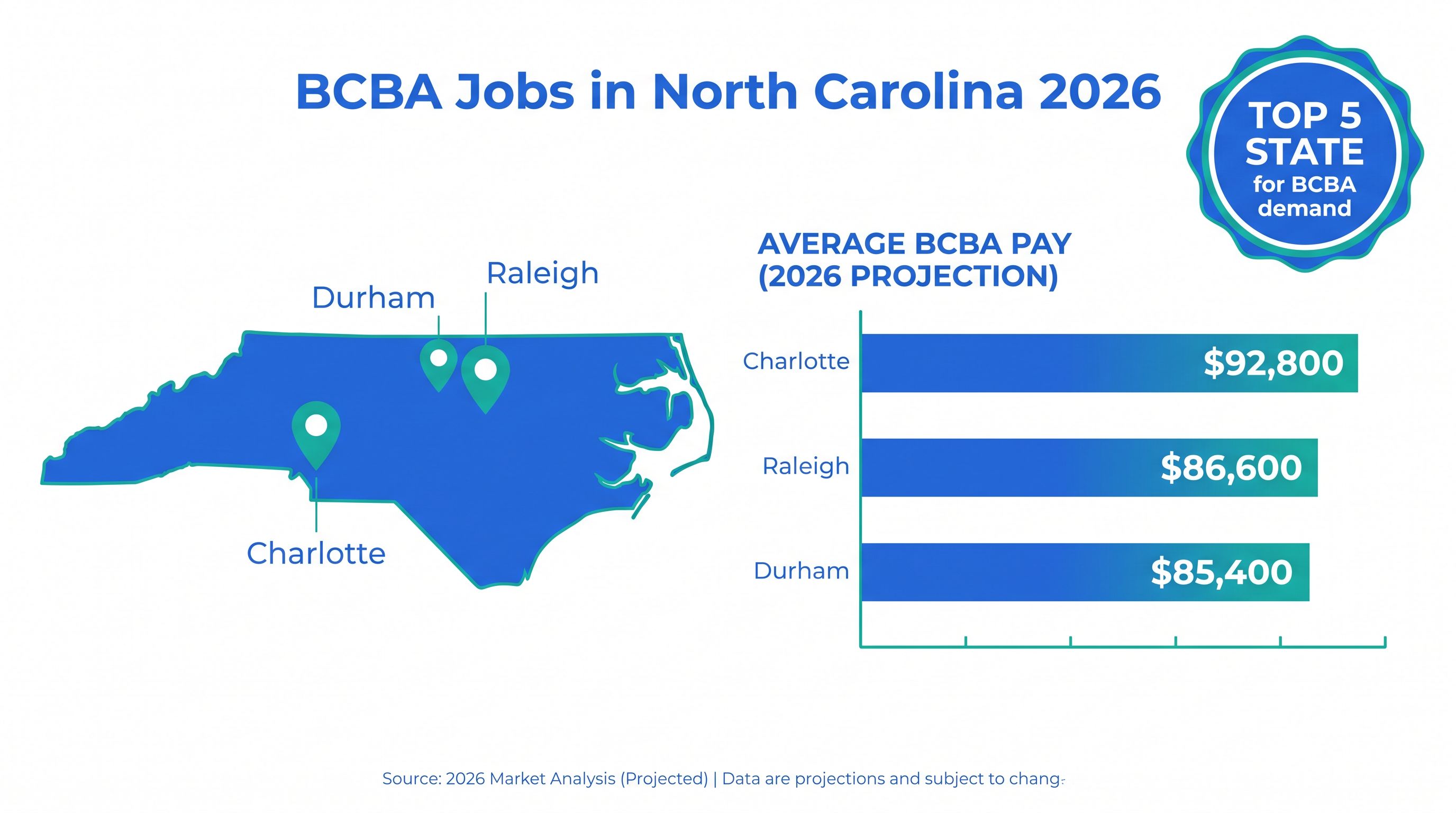
If you are a board certified behavior analyst in North Carolina, you are looking for work in one of the hottest markets in the country. North Carolina ranks among the top five states in the nation for BCBA job demand, employers are competing for a limited pool of certified analysts, and the openings far outnumber the people qualified to fill them. The question is not whether you can find a BCBA job in North Carolina; it is how to find the right role at the right pay.
This guide breaks down why demand is so high, what BCBAs actually earn across Charlotte and the Raleigh-Durham Triangle, the settings hiring right now, how state licensure works, and how to turn a shortage market into a stronger offer.
Why Demand for BCBA Jobs in North Carolina Is So High
The demand for BCBAs in North Carolina comes down to a structural imbalance: far more children qualify for services than there are analysts to serve them. In its April 2025 report, the CDC's Autism and Developmental Disabilities Monitoring Network found that 1 in 31 eight-year-olds is identified with autism spectrum disorder, up from 1 in 36 in the prior cycle. In North Carolina, autism touches more than 40,000 individuals and families, and every qualifying case that funds applied behavior analysis needs a BCBA to design and oversee the treatment.
The national math is stark. The Behavior Analyst Certification Board reports 85,587 certified BCBAs as of July 1, 2026, while employers posted 132,307 BCBA and BCBA-D jobs during 2025, a 28% jump over the year before, according to workforce analyses from Lightcast reported by Behavioral Health Business. That works out to roughly two to three open roles for every certified analyst actively looking. Our 2026 BCBA shortage analysis breaks the national gap down in detail.
North Carolina sits near the top of that curve. Industry analyses place it among just five states, alongside California, New Jersey, Texas, and Massachusetts, that together account for 38% of all BCBA job postings in the country. For a state to pull that kind of demand share is a clear signal: employers here have more roles than they can fill.
"In a market with two to three openings per analyst, the leverage sits with the candidate, not the employer."
Funding is the engine underneath it all. North Carolina mandates coverage for ABA therapy through both commercial insurance and Medicaid for eligible children, with adaptive behavior treatment covered up to $40,000 per year for individuals age 18 and under. That coverage means clinics can bill for far more service hours than their current staff can deliver, and the population growth in the Charlotte and Raleigh-Durham metros keeps expanding the pediatric caseload year over year.
BCBA Salary in North Carolina: What You Can Actually Earn
Salary data for BCBAs in North Carolina can look contradictory until you understand what you are reading. Job boards that report BCBA-specific pay run higher than broad government wage categories, and different aggregators weight their samples differently. Presented as a range, the picture is consistent: most full-time North Carolina BCBAs land in the low-to-mid $80,000s, with experienced supervisors and clinical directors clearing six figures.
ZipRecruiter puts the North Carolina average at about $80,952 per year as of mid-2026, while Indeed reports a higher average near $96,393. The middle of the market runs from roughly $67,300 at the 25th percentile to about $82,200 at the 75th, and top earners in the 90th percentile reach around $120,000. The realistic takeaway: a full-time BCBA in North Carolina can reasonably expect the low-to-mid $80,000s, and analysts who move into supervisory or director roles push well past $100,000.
For a deeper look at how pay scales with experience and setting, see our BCBA salary by state guide for 2026.
Where the Jobs Are: North Carolina Metro Breakdown
BCBA jobs in North Carolina cluster around the state's population centers, and pay tracks closely with the depth of the local market. The table below shows reported BCBA-specific averages for the largest metros; treat them as midpoints in a range, not fixed figures.
| Metro Area | Reported BCBA Average | What Stands Out |
|---|---|---|
| Charlotte | ~$92,800 | Largest market and top pay; deepest pool of clinic and in-home roles |
| Raleigh | ~$86,600 | Triangle hub; strong listing volume and competitive offers |
| Durham-Chapel Hill | ~$85,400 | Research-triangle demand; university and health-system employers |
| Greensboro-Winston-Salem (Triad) | Low-to-mid $70,000s | Growing market; lower cost of living stretches pay further |
| Fayetteville / Wilmington / Asheville | Varies | Smaller pools, but persistent unmet demand and telehealth openings |
Charlotte offers the most volume and the highest reported pay, with employers ranging from national ABA chains to boutique clinics. The Raleigh-Durham Triangle pairs strong listing counts with competitive offers, backed by universities, health systems, and a fast-growing family population. The Greensboro and Winston-Salem Triad is a growing market where a slightly lower salary goes further against a lower cost of living. Smaller metros like Fayetteville, Wilmington, and Asheville have thinner pools of analysts, which often means less competition for the roles that do open.
Types of BCBA Jobs Available in North Carolina
North Carolina's ABA sector has matured well beyond the traditional clinic floor. The roles hiring most actively in 2026 include:
- ✓ Center-based and in-home ABA. The largest segment by far, spanning national providers and independent clinics serving early intervention and school-age clients across the Charlotte and Triangle metros.
- ✓ School-based BCBA roles. Districts across the state hire analysts to support IEP teams and behavior intervention plans, often with school-calendar schedules.
- ✓ Telehealth and hybrid roles. Remote clinical supervision has become a permanent fixture, and it is a direct answer to the rural counties where no analyst practices locally.
- ✓ Hospital and insurance roles. Utilization review, care coordination, and clinical-quality positions that put your BCBA credential to work outside direct service.
- ✓ Part-time, contract, and travel. Flexible arrangements are widely available, and the shortage means you can often set your own schedule.
Do You Need a License to Work as a BCBA in North Carolina?
Yes, and this is where North Carolina differs from states like Florida that have no separate statute. North Carolina established the Behavior Analyst Licensure Board in 2021, so practicing as a behavior analyst in the state requires a state license in addition to your active BACB certification.
In practice, the license is built on the same BACB requirements you already meet, so it is a paperwork step rather than a second exam. The thing to confirm during interviews is whether a prospective employer helps with licensure and payer credentialing; good employers walk you through it, which can otherwise delay your start date by weeks.
How to Land the Best BCBA Job in North Carolina
When openings outnumber candidates, the winning strategy flips. Instead of mass-applying and hoping, you can be selective and let the market work in your favor.
- ✓ Vet for sustainability, not just salary. Ask about caseload caps, supervision ratios, indirect-time allocation, and administrative support. These factors predict burnout more than base pay does.
- ✓ Negotiate the full package. Sign-on bonuses, relocation help, CEU stipends, and productivity bonuses are all common when employers want you. If a clinic is short-staffed, these are on the table.
- ✓ Compare offers side by side. With demand this high, there is no reason to accept the first bid before you know what a second and third employer will offer.
That is exactly the dynamic CertifyndABA is built around. Instead of scattering your resume across job boards, you create one anonymous profile, and verified North Carolina employers send you interview requests based on your qualifications. Your name and contact details stay private until you choose to accept, so you can weigh multiple offers without your current employer ever knowing you are looking.
Frequently Asked Questions
How much does a BCBA make in North Carolina?
Most full-time BCBAs in North Carolina earn in the low-to-mid $80,000s. ZipRecruiter reports a statewide average near $80,952 in 2026, while Indeed reports about $96,393. Top earners and clinical directors reach roughly $120,000. Charlotte and the Raleigh-Durham Triangle sit at the higher end of the range.
Are BCBAs in demand in North Carolina?
Yes. North Carolina ranks among the top five states in the nation for BCBA demand, alongside California, New Jersey, Texas, and Massachusetts, which together account for 38% of all U.S. postings. Nationally the profession averages roughly two to three open roles for every certified analyst, driven by rising autism identification and mandated insurance coverage.
Which North Carolina city has the most BCBA jobs?
Charlotte has the largest number of openings and employers, along with the highest reported pay, followed by the Raleigh-Durham Triangle. Both metros host national ABA chains, independent clinics, school systems, and health-system employers competing for analysts.
Do you need a license to be a BCBA in North Carolina?
Yes. North Carolina requires a license through the North Carolina Behavior Analyst Licensure Board, established in 2021, in addition to your active BACB certification. The license is based on the same BACB requirements, so it is a credentialing step rather than a separate exam.
Are remote or telehealth BCBA jobs available in North Carolina?
Yes. Telehealth and hybrid supervision roles are widely available and growing, in part because more than half of U.S. counties have no practicing BCBA. Remote roles let analysts serve rural North Carolina families who cannot access a local clinic.
The Bottom Line on BCBA Jobs in North Carolina
North Carolina in 2026 is a candidate's market. It ranks among the top five states for BCBA demand, pay for BCBA-specific roles runs into the mid $80,000s and beyond, and openings are spread across every major metro and setting. The analysts who do best are not the ones who apply to the most jobs; they are the ones who let qualified employers come to them and then negotiate from a position of strength.
Let North Carolina employers compete for you
Create a free, anonymous CertifyndABA profile and receive interview requests from verified North Carolina ABA employers. Your identity stays private until you decide to respond.
Create Your Free Profile