


The BCBA taxonomy code is 103K00000X, "Behavior Analyst." It is the code you list on your National Provider Identifier (NPI) so payers and employers know what kind of provider you are. BCBA-Ds use the same code. BCaBAs use 106E00000X, and RBTs use 106S00000X. If you are starting your first BCBA job or changing employers, check this code before your new employer starts credentialing you, because the NPI registry is messier than most people assume.
The BCBA taxonomy code and its two siblings
Taxonomy codes come from the Health Care Provider Taxonomy code set, which the National Uniform Claim Committee (NUCC) maintains. The NPI system and most payers use it. Behavior analysis has three codes, all in the "Individual" section of the set.
| Code | NUCC name | Who uses it | In the code set since |
|---|---|---|---|
| 103K00000X | Behavior Analyst | BCBAs, BCBA-Ds and state-licensed behavior analysts | July 1, 2008 (definition revised 2016) |
| 106E00000X | Assistant Behavior Analyst | BCaBAs and state-credentialed assistants | July 1, 2016 |
| 106S00000X | Behavior Technician | RBTs and other technicians | July 1, 2016 |
The NUCC definition of 103K00000X describes a provider with at least a master's degree who holds BACB certification, a state credential, or both, and who can practice on their own and supervise others. There is no separate code for the BCBA-D. A doctorate does not change your taxonomy code. Other codes, such as 103T00000X (Psychologist) or 101YM0800X (Mental Health Counselor), belong to people who hold those licenses. A BCBA without that license should not use them.
What the NPI registry shows about the behavior analyst code
We filtered the full November 2026 NPPES file from CMS, about 9.9 million NPIs, for the three behavior analysis codes. Then we compared the results with the BACB's live count of US certificants. The results show why the code you list matters.
| Code | Individual NPIs | Organization NPIs | Active US certificants (BACB) |
|---|---|---|---|
| 103K00000X Behavior Analyst | 119,558 | 21,434 | 82,451 BCBA and BCBA-D |
| 106E00000X Assistant Behavior Analyst | 13,531 | 1,764 | 4,527 BCaBA |
| 106S00000X Behavior Technician | 632,706 | 3,583 | 275,606 RBT |
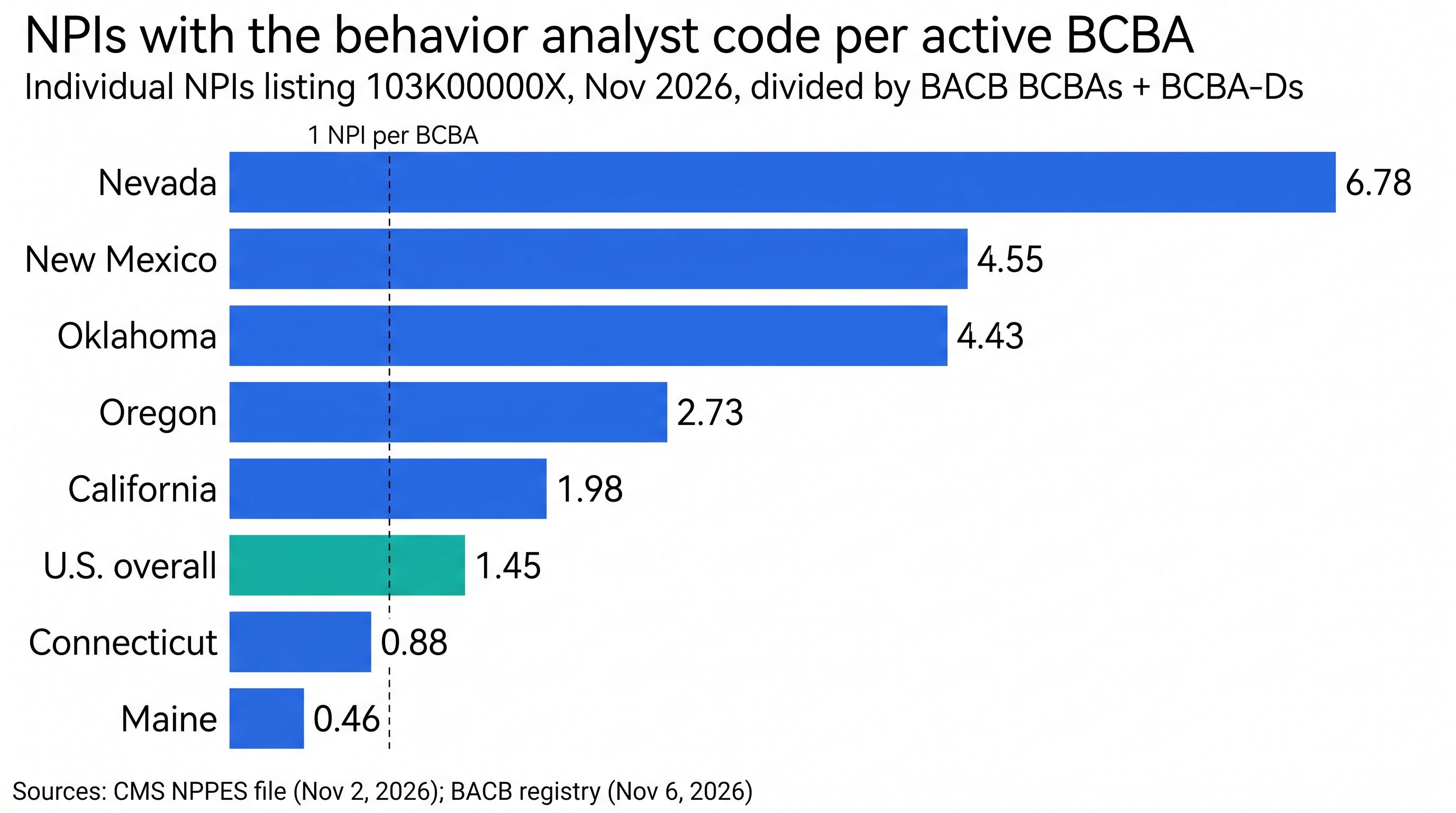
That is about 1.45 individual NPIs with the behavior analyst code for every active US BCBA. The gap is not proof of misuse, and these are our readings of the data, not something the file states. An NPI does not expire when a certification lapses, so people who left the field still appear. Some states license behavior analysts outside the BACB. State rules and Medicaid enrollment practices differ too. Nevada, for example, shows 4,927 individual NPIs with 103K00000X against 727 BCBAs and BCBA-Ds, and we did not test why. The range runs from 0.46 per BCBA in Maine to 6.78 in Nevada.
Researchers have flagged this before. In "The Misclassification of Behavior Analysts," published in Behavior Analysis in Practice (2021), Dubuque, Yingling and Allday matched NPPES records from April 2019 against the BACB registry. They found 49,618 providers using 103K00000X and estimated that roughly two in five did not hold the credential the code requires. The paper does not make clear whether that figure includes organizations. Either way, the count has grown fast: 119,558 individual NPIs list the code today, and 140,992 when organizations are included.
Three NPI problems that slow down a new BCBA job
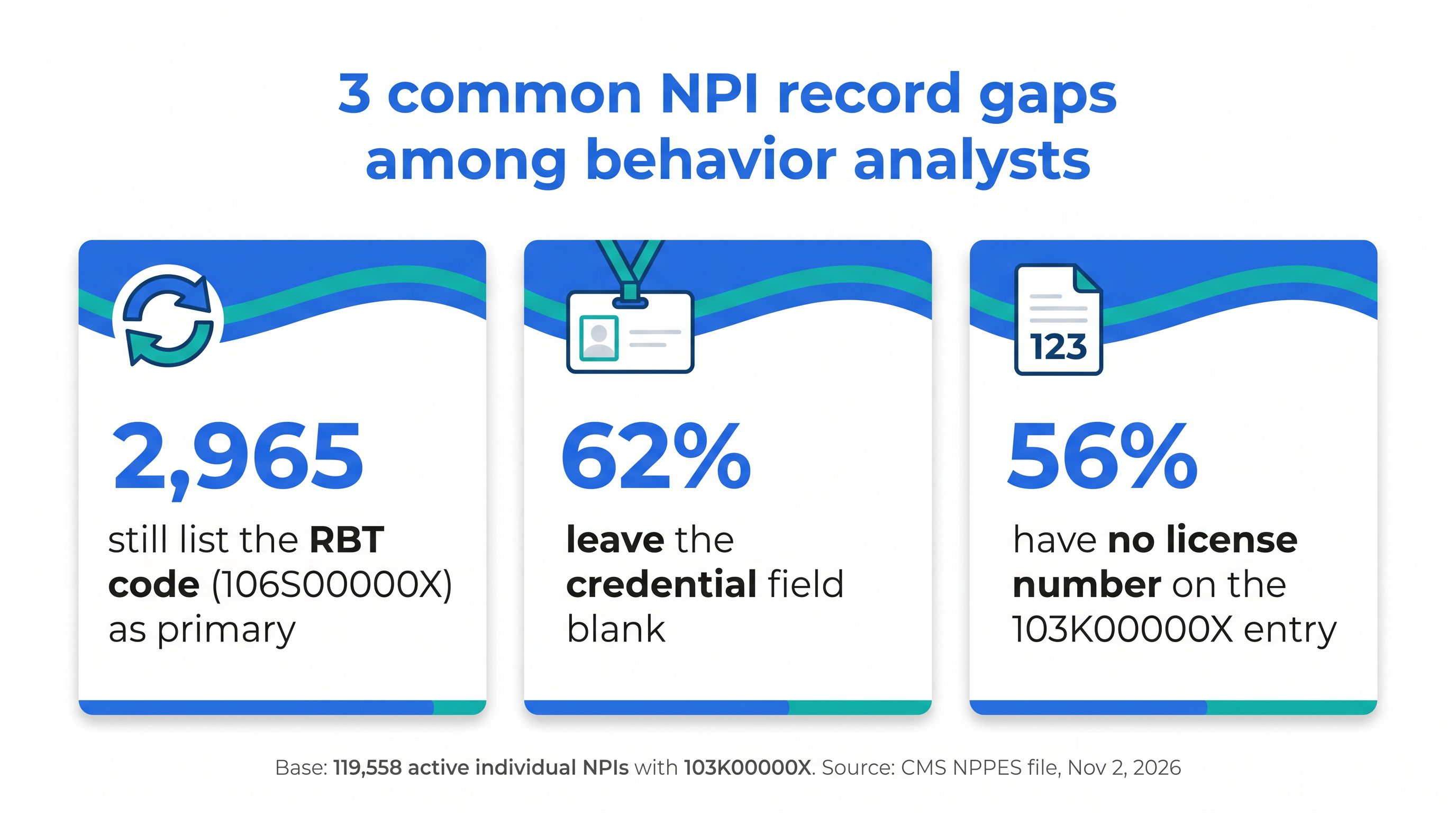
Your NPI belongs to you, not your employer. Individuals are eligible for only one NPI, according to the CMS NPI fact sheet, so the same number goes with you from job to job. So mistakes on your record follow you into every new credentialing file. In the November file, three are common.
- 1 The old RBT code is still primary. 15,778 individuals list both 103K00000X and 106S00000X, which is what you see when an RBT becomes a BCBA and adds the new code. For 2,965 of them (19%), Behavior Technician is still marked as the primary taxonomy.
- 2 No credential on the record. 62% of individuals with the behavior analyst code leave the credential field blank. Only 28% list BCBA or BCBA-D there.
- 3 No license number on the 103K entry. 44% list a license or certification number with the code. If you hold a state behavior analyst license, it belongs on that entry, in your license state.
None of these blocks you from being hired. They can prompt questions from a credentialing specialist, and a record that does not match the role you are being credentialed for is one more thing to explain. Fixing it takes a few minutes.
How to set up your NPI and BCBA taxonomy code before a new job
Do this when you pass the exam or accept an offer, not after your start date.
- Look up your NPI. Search your name on the free NPI Registry. If you were an RBT, you may already have one. Do not apply for a second Type 1 NPI.
- Apply if you have none. Apply online through NPPES, which CMS calls the fastest route. A paper form (CMS-10114) exists, and some employers submit in bulk for staff.
- Set 103K00000X as primary. Add the code, mark it primary, and remove 106S00000X if you no longer work as a technician.
- Add your credential and license. Put "BCBA" in the credential field. Add your state license number to the 103K entry if your state licenses behavior analysts.
- Update your practice address within 30 days. CMS requires covered providers to report NPPES changes within 30 days (45 CFR 162.410). A new job usually means a new address.
- Refresh your CAQH profile. Many commercial payers pull from CAQH ProView, which asks you to re-attest every 120 days in most states. An expired profile stalls credentialing.
- Ask about Medicaid enrollment. Some state Medicaid programs enroll BCBAs individually under 103K00000X. North Carolina, for example, requires proof of an active BCBA certification, and since August 2026 it limits individual enrollment under this code to in-state and border providers.
Questions to ask employers about credentialing
Insurance credentialing commonly takes 90 to 120 days, and sometimes 60 to 150 or more, based on credentialing vendors' estimates. Payers differ on whether they back-date your effective date. That makes credentialing a fair topic for an interview or offer conversation, alongside the questions in our guide to questions to ask in an ABA interview:
- Who handles credentialing, and how long does it usually take here?
- What do I do, and how am I paid, before I am credentialed with each payer?
- Does my pay or productivity target depend on billable hours during that period?
- Will you bill under my NPI or a group NPI?
With more than 82,000 active US BCBAs and the BACB's Lightcast report counting 132,307 US postings in 2025 that required or preferred a BCBA or BCBA-D, you are usually not asking these questions from a weak spot. Our BCBA salary guide covers the pay side of the same conversation.
Frequently asked questions
What is the taxonomy code for a BCBA?
The taxonomy code for a BCBA is 103K00000X, Behavior Analyst. BCBA-Ds use the same code, because NUCC has no separate doctoral code for behavior analysts.
What taxonomy code does a BCaBA use?
BCaBAs use 106E00000X, Assistant Behavior Analyst. NUCC added it in July 2016, along with 106S00000X for behavior technicians.
Can a BCBA use the psychologist or counselor taxonomy code?
Only if they also hold that license. Codes such as 103T00000X and 101YM0800X describe licensed psychologists and counselors. A BCBA without that license should list 103K00000X.
Do I need a new NPI when I change ABA jobs?
No. Individuals get only one NPI. You update your practice address and details in NPPES within 30 days instead. Your employer may also have its own Type 2 group NPI.
How do I change my taxonomy code from RBT to BCBA?
Sign in to NPPES, add 103K00000X, mark it as your primary taxonomy, and remove 106S00000X if you no longer work as a technician. Then update CAQH so payers see the change.
Method: we filtered the CMS NPPES monthly file released November 2, 2026 (9,891,116 records) for any of the 15 taxonomy fields holding 103K00000X, 106E00000X or 106S00000X. Counts are NPIs that are not currently deactivated (including 1,284 reactivated records), by practice location state, and include state-licensed analysts and a few NPIs outside the 50 states and DC. BACB counts come from the certificant registry region page on November 6, 2026. The two sources use different dates and scopes, so ratios are approximate.
Let employers come to you
Your NPI is ready and your credentials are current. On CertifyndABA, qualified employers send you interview requests with pay listed, and your identity stays private until you accept.
Create Your Free Profile