


If you are searching for BCBA jobs in New York, you are entering a market that shifted sharply in your favor over the past two years. New York employers posted 4,902 jobs requiring or preferring BCBA certification in 2025, up from 3,026 the year before, according to the Behavior Analyst Certification Board's employment demand report prepared with Lightcast. That is 62% growth in twelve months, the second-fastest rate among the ten states with the most BCBA postings, behind only North Carolina.
The Employment Gap Behind BCBA Jobs in New York
Demand growth only matters if supply cannot keep up, and in New York it cannot. The BACB's region-specific certificant data shows roughly 3,311 BCBAs and 177 BCBA-Ds practicing in the state, about 3,488 certified analysts in total. Set that against 4,902 job postings and you get roughly 1.4 postings for every certified analyst in New York.
That ratio actually understates your leverage. Nearly all of those 3,488 analysts already hold jobs, so the pool of candidates genuinely available to a hiring manager on any given week is a small fraction of the headline number. It is worth being precise about what the data measures: these are job postings, which the Lightcast database de-duplicates within its own sources, not a live count of unfilled seats.
A useful credibility check comes from comparing two independent registries. The BACB reports 3,311 BCBAs in New York; the New York State Education Department reports 3,081 licensed behavior analysts residing in the state as of January 1, 2026. Two separate bodies counting in different ways landed within about 7% of each other, which gives real confidence that New York's practicing supply sits somewhere near 3,100 to 3,300.
How Strong Is BCBA Demand in New York?
New York ranks ninth nationally by BCBA posting volume but second by growth among high-volume states. Nationally, postings reached 132,307 in 2025, a 28% increase over 2024, so New York is outpacing an already fast market by more than two to one.
The supply bottleneck is the exam. BACB data shows the first-time BCBA pass rate falling from 60% in 2021 to 51% in 2025. More telling still, 2025 saw 13,196 retake candidates against just 9,955 first-time candidates; more people are re-sitting the exam than taking it for the first time.
New York's own training pipeline shows the same strain. In the BACB's 2024 university pass-rate report, the two largest New York cohorts posted below-midpoint results: Russell Sage College at 46% across 70 first-time candidates and Manhattanville College at 49% across 61. Teachers College at Columbia University, the only New York institution on ABAI's accredited program list, posted 76% across 17 candidates. Worth noting that BACB does not publish results for programs with fewer than six first-time candidates, so a program's absence reflects a small cohort rather than weak performance, and BACB explicitly cautions against comparing any single program against the overall exam rate.
New York has grown its own ranks considerably. A peer-reviewed analysis of BACB certificant growth found New York ranked fourth nationally with 1,938 BCBAs and BCBA-Ds as of mid-2019. Reaching roughly 3,488 today represents about 80% growth in seven years. Demand simply grew faster.
"New York added 1,876 more BCBA job postings in 2025 than in 2024. It did not add anywhere near 1,876 new behavior analysts."
One structural quirk shapes daily work in New York: the assistant tier barely exists. The state counts just 39 BCaBAs, and its own equivalent credential, the Certified Behavior Analyst Assistant, had only 24 holders as of January 2026. New York teams are therefore built around BCBAs and RBTs with almost nothing in between, which means analysts there typically carry a heavier direct supervision load than peers in states with a healthy mid-tier.
New York Requires a State License, Not Just Your BCBA
This is the single biggest thing that separates BCBA jobs in New York from most other states, and it is the detail job boards never explain. New York regulates behavior analysis as a licensed profession. You need a Licensed Behavior Analyst credential from the New York State Education Department. NYSED states the position plainly: "BACB certification alone is not sufficient to practice as an LBA in New York State. Such certification provides a path to licensure; it is not an exemption from licensure."
The good news is that the path is short. Since November 22, 2022, Subpart 79-17.6 has allowed applicants holding certification from an acceptable national certifying body to be licensed "without meeting additional requirements as to examination, experience and education." For a current BCBA that means no state exam, no repeat fieldwork, and no additional coursework. You submit Form 1 with the fee and have the BACB send verification directly to NYSED.
The licensing data shows exactly how much that mattered. New York issued 205 LBA licenses in 2021 and 207 in 2022. In 2023, the first full year after the pathway opened, it issued 850, then 680 in 2024 and 714 in 2025. Total licensed behavior analysts reached 4,438 as of January 1, 2026.
Current fees are $300 for the application, covering the $200 license and $100 first triennial registration, then $100 per triennial renewal. A limited permit costs $70 and a graduate permit $10. Two limits are worth knowing before you apply: the LBA scope covers autism and related disorders rather than behavior analysis generally, and practice requires a diagnosis and prescription from another authorized licensed professional, so an LBA does not self-initiate services. NYSED does not publish a processing-time estimate, so build in buffer rather than trusting timelines you see quoted elsewhere.
The Exemption Rule That Trips Up Most BCBAs
Section 8807 of the Education Law exempts several categories of workers from the licensure requirement, and here is the part almost every guide misses: exemptions attach to the employer, not to you. The same BCBA can work lawfully without a license at a public school and be practicing unlawfully at a private clinic across the street.
The main exemptions cover people employed by federal, state, county or municipal agencies; chartered elementary and secondary schools and degree-granting institutions; certified teachers and teaching assistants in approved programs; Early Intervention providers under Public Health Law; and graduates completing supervised experience toward certification, provided they are supervised by a New York licensed and registered LBA.
Whatever your exemption status, one rule is absolute: without the license you may never use the title Licensed Behavior Analyst. Practically, being unlicensed does not lock you out of New York; schools, county agencies, Early Intervention and the large state-regulated provider networks are all open. It does lock you out of private practice and unexempt clinics, which is where much of the top-end pay sits.
BCBA Salary in New York: What You Can Actually Earn
Indeed puts the New York statewide average at $91,721 based on 936 salaries drawn from job postings over a trailing 36 months, updated July 11, 2026, with a reported range of $71,069 to $118,374. Salary.com, which models employer survey data rather than advertised pay, puts New York City's median at $81,330. Those two numbers differ by roughly $14,600 for the same city, and they should not be averaged together; they measure different things, and advertised pay usually runs ahead of surveyed pay.
You may also see BCBA pay quoted from Bureau of Labor Statistics figures. Treat those carefully. BLS has no occupation code for behavior analysts, and the two codes commonly used as proxies bracket the truth rather than capture it: New York's median for Community Health Workers is $58,130 while Psychologists, All Other sits at $128,320. A $70,190 spread between two proxies for the same job is the clearest possible sign that neither one is measuring BCBAs.
For a fuller breakdown by experience level and setting, see our guide to BCBA salary in New York.
Where the Jobs Are: New York Metro Breakdown
The most useful finding for anyone weighing a move is that New York pays remarkably flat across the state while costing wildly different amounts to live in.
| Market | Average (Indeed) | Sample |
|---|---|---|
| Brooklyn | $95,941 | 86 salaries |
| New York City | $95,914 | 145 salaries |
| Queens | $94,229 | 77 salaries |
| Buffalo | $92,986 | 41 salaries |
| Bronx | $92,424 | 52 salaries |
| Melville (Long Island) | $83,848 | 21 salaries |
| Rochester | $83,162 | 21 salaries |
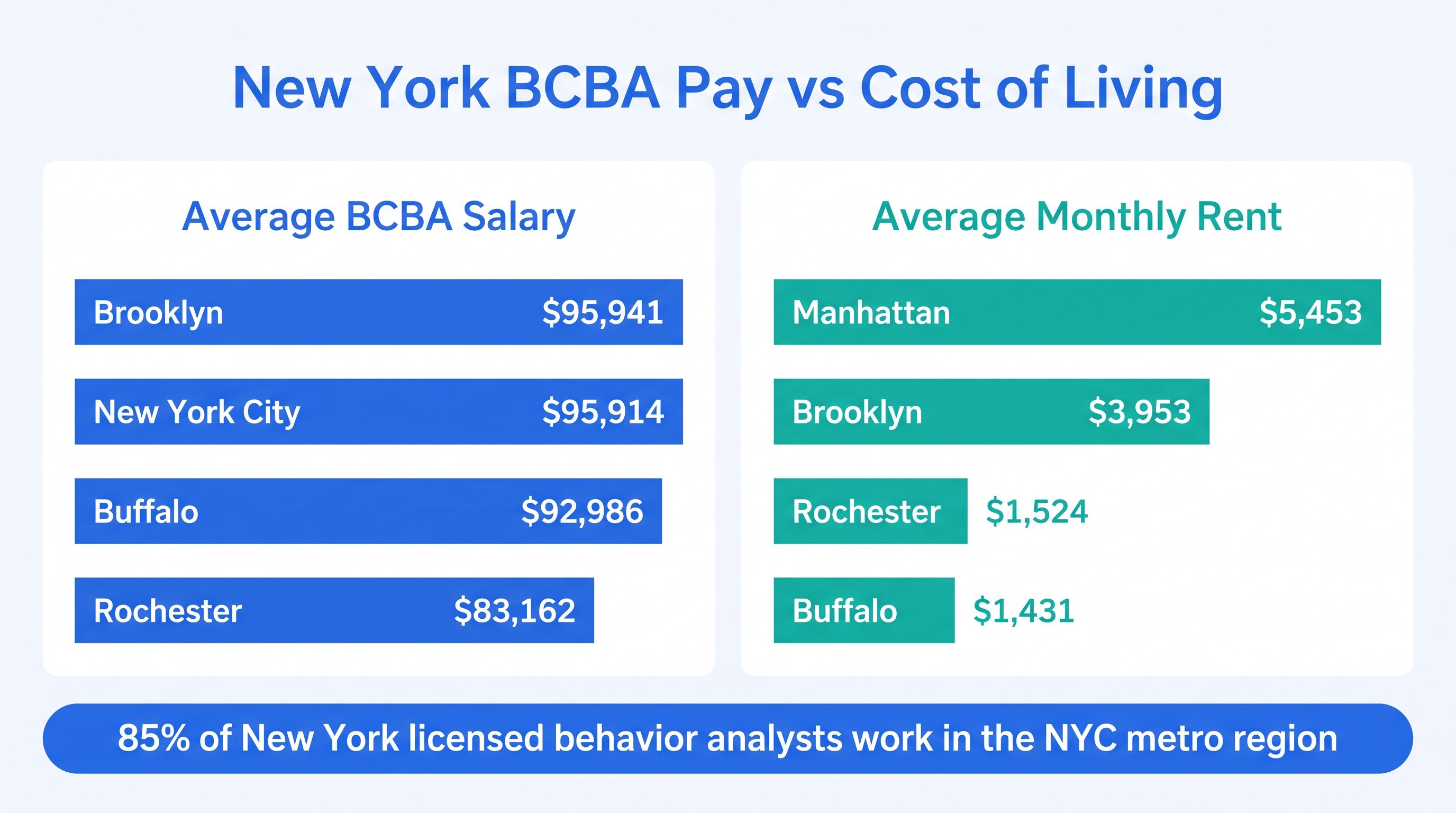
Buffalo pays within about 3% of New York City. Buffalo's cost of living including rent runs roughly 45% lower than the city's, per Numbeo's July 2026 comparison, and average rent is $1,431 against $3,953 in Brooklyn and $5,453 in Manhattan. Numbeo's Rochester comparison makes the point bluntly: about $6,037 there supports the standard of living that $12,000 buys in New York City. On real purchasing power, upstate wins comfortably.
Two caveats keep this honest. Albany at $89,659 and Syracuse at $78,274 each rest on only ten reported salaries, so treat them as directional rather than firm. And Long Island is thinly sampled overall; Melville is the only Long Island figure with a defensible sample size, and it lands below the city.
Supply is concentrated in a way that shapes competition. Using NYSED's county licensure data, the five boroughs hold about 1,169 licensed analysts, Long Island 910 and Westchester with the Hudson Valley 537. Roughly 85% of New York's licensed behavior analysts sit in the New York City metro region. Kings County alone, with 549, nearly doubles the four major upstate metros combined. If you are willing to work upstate, you are competing against a far shallower bench.
Types of BCBA Jobs Available in New York
New York's employer mix is distinctive, and where you look determines whether the license question even arises.
- ✓ Large nonprofit developmental disability agencies. AHRC NYC, QSAC, Eden II Programs and The Summit Center in Buffalo are among the biggest employers of behavior analysts in the state.
- ✓ Early Intervention and home-based providers. Agencies such as Achieve Beyond and New York Therapy Placement staff the birth-to-three system, which operates under its own licensure exemption.
- ✓ Private ABA clinics. This is where licensure is non-negotiable and where posted pay often runs highest; Brooklyn clinic postings in the $110,000 to $115,000 range are not unusual.
- ✓ Schools, but not the ones you would guess. New York City's Department of Education was not observed posting BCBA roles directly. School-based demand routes through charter networks, approved private special education schools and contracted agencies. Searching only the DOE careers page will hide most of this work from you.
The Early Intervention system deserves particular attention because its capacity problems are documented at the state level. A New York State Comptroller audit found that 27,000 of 189,000 referred children, about 14%, were never evaluated, and that 28% of children with an approved service plan did not begin services within the required 30 days. The advocacy coalition ACTS testified to the State Senate in February 2026 that roughly 10,000 children sit on waiting lists and that New York ranks 48th nationally for timely service delivery; that figure comes from testimony arguing for a reimbursement rate increase, so weigh it accordingly.
In fairness to the counter-argument, behavior analysis does not appear on New York's designated teacher and related-service shortage-area lists. Special education broadly is designated; ABA specifically is not. The posting data carries the demand case well enough without overstating it.
How to Land the Best BCBA Job in New York
Start the LBA application before you start applying to jobs, not after you get an offer. Licensure is what moves you from the exempt-employer segment of the market into all of it, including the private clinics where pay peaks. If you already hold your BCBA, the pathway waives exam, experience and education, so the main cost is processing time rather than effort.
If you are not licensed yet, work the exemption map deliberately. School districts, county agencies, Early Intervention providers and OPWDD, OCFS and OMH regulated programs can hire you now, and that last category is secure through July 1, 2030.
Negotiate from the data. A market with 62% posting growth, roughly 1.4 postings per certified analyst and a falling national exam pass rate is not one where you should accept the first number offered. Our guide to BCBA salary negotiation covers how to frame that leverage, and common BCBA interview questions will help you prepare.
Finally, compare offers on purchasing power rather than headline salary. A $93,000 offer in Buffalo and a $96,000 offer in Brooklyn are not remotely the same job financially.
Frequently Asked Questions
Do you need a license to be a BCBA in New York?
Yes, in most settings. New York requires a Licensed Behavior Analyst credential from NYSED, and BACB certification alone does not authorize practice. Exemptions exist for employees of public agencies, chartered schools, Early Intervention providers, and OPWDD, OCFS and OMH regulated programs, but those attach to the employer rather than to you.
How much does a BCBA make in New York?
Indeed reports a statewide average of $91,721 from 936 reported salaries, with a range of roughly $71,000 to $118,000. New York City averages $95,914 while Buffalo averages $92,986, so pay is fairly flat statewide even though costs are not.
Are BCBAs in demand in New York?
Yes. New York employers posted 4,902 BCBA jobs in 2025 against roughly 3,488 certified analysts statewide, and posting volume grew 62% in a single year, the second-fastest growth among the ten highest-volume states.
Which part of New York has the most BCBA jobs?
The New York City metro region dominates, holding about 85% of the state's licensed behavior analysts. That also means the most competition. Upstate markets like Buffalo and Rochester have far shallower candidate benches relative to demand.
Can I work in New York while my LBA application is pending?
Possibly, depending on your employer. A limited permit is available for $70 to applicants who meet all requirements except examination or experience, and permit holders must practice under supervision. Exempt employers can also hire you while you wait. NYSED does not publish a processing-time estimate, so confirm your situation with the Office of the Professions before accepting a role.
The Bottom Line on BCBA Jobs in New York
New York in 2026 is a candidate's market with a paperwork gate in front of it. Demand grew 62% in a year against a supply of roughly 3,488 certified analysts, the exam pipeline feeding that supply is getting narrower rather than wider, and the state's near-total lack of an assistant tier concentrates work onto BCBAs. The LBA license is the one genuine hurdle, and for existing BCBAs it is a filing exercise rather than a requalification. Handle it early and the entire market opens to you. The analysts who do best here are not the ones who apply to the most postings; they are the ones who get licensed, look past the New York City metro where 85% of the competition sits, and let qualified employers come to them.
Let New York employers compete for you
Create a free, anonymous CertifyndABA profile and receive interview requests from verified New York ABA employers. Your identity stays private until you decide to respond.
Create Your Free Profile