

BCBA salary in New York ranges from $92,000 to $120,000 in 2026, depending on the data source and whether you work in the five boroughs or upstate. New York consistently ranks among the highest-paying states for behavior analysts; some NYC boroughs report averages above $130,000. But the real question is whether those numbers hold up after New York's notoriously high cost of living.
This guide breaks down what BCBAs actually earn across New York by metro area, experience level, and work setting. We also look at what your salary is worth after cost of living and why the state's severe workforce shortage gives you real leverage at the negotiating table.
Average BCBA Salary in New York: The Numbers
Salary data for New York BCBAs varies across platforms, but the overall picture is clear: the state pays well above the national average.
Here is how the major salary platforms report New York BCBA compensation:
| Source | Average / Median | Range | Scope |
|---|---|---|---|
| Indeed (June 2026) | $91,656 | $70,976 - $118,362 | NY statewide (910 reports) |
| Glassdoor (2026) | $117,060 | $93,857 - $146,819 | NYC metro |
| ZipRecruiter (May 2026) | $97,451 | ~$46.85/hr | NYC |
| Salary.com (2026) | ~$119,540 | $93,629 - $153,318 | NYC |
The wide spread between Indeed's statewide $91,656 and Glassdoor's NYC-focused $117,060 reflects a real divide. New York City pulls the average up significantly, while upstate positions bring it down. Both numbers are accurate; they just measure different slices of the market.
BCBA Salary by New York Metro Area
Geography is the single largest factor in New York BCBA pay. The NYC boroughs and Long Island command significantly more than the rest of the state.
| Location | Average Salary | Notes |
|---|---|---|
| Queens | $135,339 | Highest-paying borough; dense client base |
| Staten Island | $135,153 | High pay with slightly lower housing costs than Manhattan |
| Bronx | $134,824 | Strong demand for bilingual BCBAs |
| Long Island | $131,634 | Suburban market with school-district positions |
| Brooklyn | $127,152 | Large ABA agency presence |
| NYC overall | $97,000 - $117,000 | Range reflects platform and methodology differences |
| Albany-Schenectady | $85,000 - $95,000 | State capital; government and school positions |
| Buffalo-Niagara | $80,000 - $90,000 | Growing market with lower cost of living |
Source: Indeed salary data (June 2026, 910 reports) for borough-level figures; industry estimates for upstate metros.
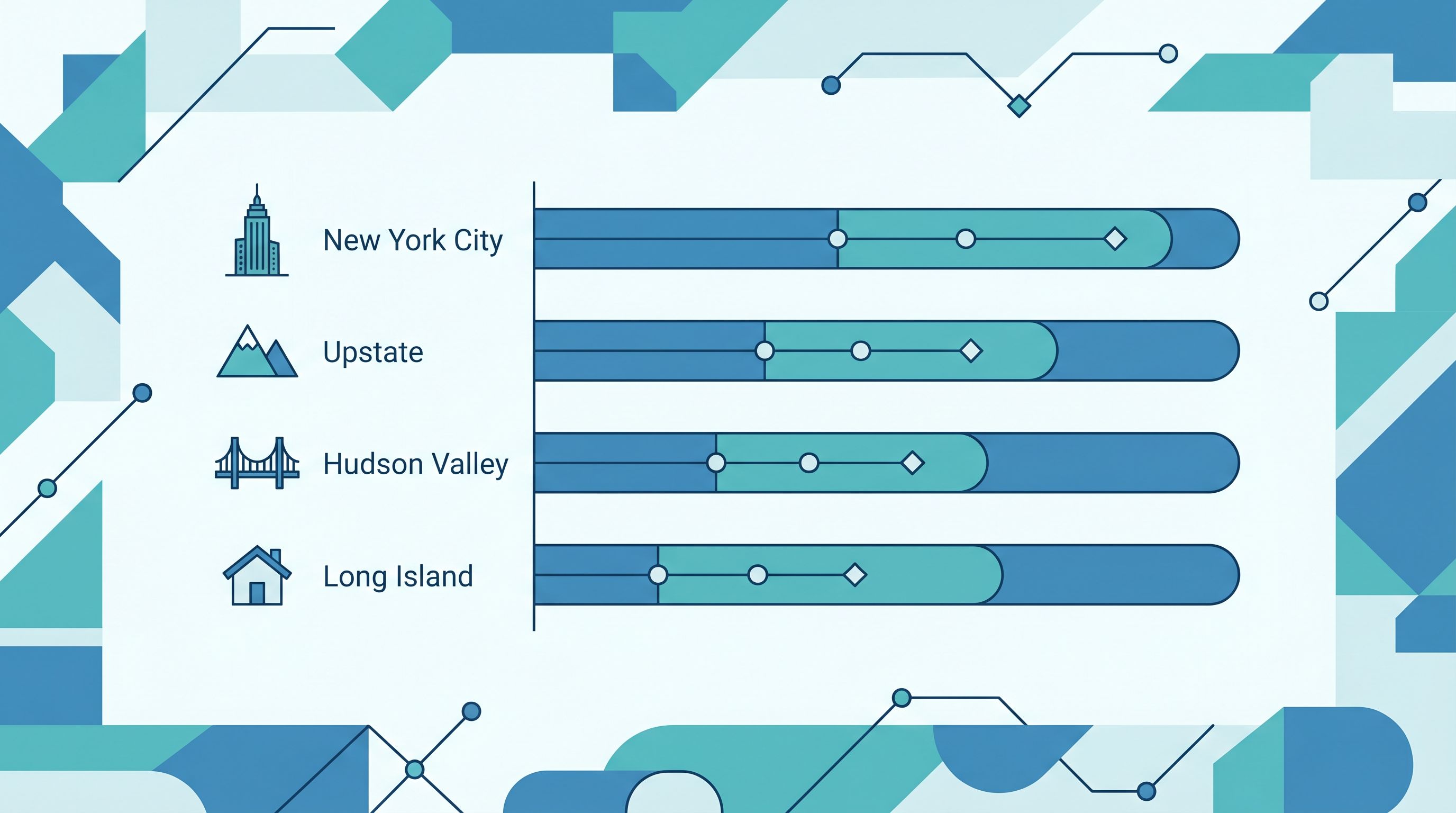
The borough-level numbers deserve context. Queens, Staten Island, and the Bronx lead not because those boroughs have wealthier employers, but because they have high concentrations of families seeking ABA services combined with fewer BCBA practices than Manhattan. That supply-demand imbalance drives compensation upward. Brooklyn trails slightly but still exceeds $127,000 on average.
The $40,000-$50,000 gap between NYC boroughs and upstate cities like Buffalo is significant. But as the cost-of-living section below shows, that gap narrows substantially in real purchasing power.
BCBA Salary in New York by Experience Level
Experience matters everywhere, but in New York the premium for seniority is especially steep:
| Experience | Salary Range | Typical Profile |
|---|---|---|
| Entry-level (0-2 years) | $65,000 - $80,000 | New BCBAs in clinic or home-based roles |
| Mid-career (3-5 years) | $85,000 - $105,000 | BCBAs with caseload management experience |
| Senior (5-8 years) | $100,000 - $125,000 | Supervisory BCBAs, program leads |
| Clinical director (8+ years) | $120,000 - $155,000+ | Multi-site oversight, organizational leadership |
New BCBAs in NYC can expect starting salaries toward the higher end of the entry range, particularly at larger ABA agencies competing for talent. A 20-30% salary increase in the first two years is realistic for BCBAs who specialize in high-demand areas like early intervention or build strong supervision skills.
The top of the pay scale in New York is notably high. Several ABA agencies post positions above $200,000 annually, including Excellent Home Care ($223,600), PATHWAYS ($218,400), and Applied ABC ($202,800) according to Indeed job postings. These tend to be senior leadership or multi-location supervisory roles, but they illustrate how high the ceiling can go in this market.
BCBA Salary by Work Setting in New York
Where you practice shapes your paycheck almost as much as where you live:
- ✓ Private ABA agencies and clinics: $90,000 - $120,000. The highest volume of positions. Compensation often includes productivity bonuses, CEU reimbursement, and supervision hours for those pursuing BCBA-D.
- ✓ Hospitals and healthcare systems: $85,000 - $110,000. Growing segment in New York. Hospital-based roles often come with stronger benefits packages including pension plans and tuition assistance.
- ✓ Schools and school districts: $70,000 - $95,000. Lower base pay, but NYC Department of Education positions include robust benefits, summers off, and pension eligibility. New York's school system is one of the largest employers of BCBAs in the country.
- ✓ Early intervention programs: $80,000 - $100,000. New York operates one of the nation's largest early intervention systems, creating steady demand for BCBAs who work with children under three.
- ✓ Insurance and utilization review (non-clinical): $90,000 - $115,000. A growing niche where BCBAs review ABA treatment plans for insurance companies. These roles are often fully remote.
- ✓ Independent contracting: $80 - $100+/hr. Experienced BCBAs in the NYC metro frequently contract at premium hourly rates, though they manage their own taxes, benefits, and liability insurance.
What Your BCBA Salary Is Really Worth in New York
New York pays more, but it also costs more. How much more depends on exactly where you live.
New York City's cost of living is 131.5% above the national average, driven primarily by housing costs that run 61% higher than the rest of the country. Monthly expenses average $3,143 for a single person and $6,922 for a family of four. Over 62% of New Yorkers spend more on living costs than their wages and government benefits cover.
That context matters for salary evaluation. Here is a rough comparison of what different New York salaries buy in real purchasing power:
| Location | Nominal Salary | Cost-of-Living Index | ~National Equivalent |
|---|---|---|---|
| NYC (Manhattan) | $117,000 | 231 | ~$50,600 |
| NYC (outer boroughs) | $130,000 | 180 | ~$72,200 |
| Long Island | $131,634 | 155 | ~$84,900 |
| Albany | $90,000 | 101 | ~$89,100 |
| Buffalo | $85,000 | 88 | ~$96,600 |
The numbers tell a striking story. A BCBA earning $85,000 in Buffalo has better purchasing power than one earning $117,000 in Manhattan. Long Island and the outer boroughs hit a middle ground where high salaries and somewhat more manageable living costs combine for a solid standard of living.
"The highest nominal salary does not always mean the highest quality of life. New York BCBAs should weigh total compensation, commute costs, and housing before accepting an offer based on base pay alone."
This does not mean NYC positions are a bad deal. Manhattan and the boroughs offer denser client populations, more career advancement opportunities, access to specialized settings (hospitals, research institutions, early intervention centers), and a higher long-term earning ceiling. The trade-off is real, but so are the career benefits.
Why New York BCBA Salaries Keep Rising
Three forces are pushing BCBA pay upward across the state, with no sign of slowing.
1. A nationwide supply-demand gap that hits New York hard
Nationally, 132,307 job postings requested BCBA certification in 2025, a 28% increase over 2024, according to the BACB's Lightcast employment report. Only 83,586 BCBAs held active certification as of April 2026. That is roughly 1.6 open positions for every available BCBA.
New York has 3,294 BCBAs plus 177 BCBA-Ds serving a state of nearly 20 million people. That works out to about 17.3 BCBAs per 100,000 residents, below the national average and well behind Massachusetts (55.1 per 100,000). The math is straightforward: employers have to compete on salary to attract and retain talent.
2. Expanding insurance mandates and early intervention
New York's autism insurance mandate requires coverage of ABA therapy under state-regulated plans. Combined with one of the country's largest early intervention programs for children under three, the pipeline of families seeking ABA services continues to grow. Every new client who enters the system requires BCBA-level oversight for treatment planning and supervision, intensifying demand for certified professionals.
3. High RBT supervision needs
New York has 2,419 RBTs according to BACB data, each of whom requires ongoing BCBA supervision. As the number of RBTs grows, the supervisory workload for BCBAs increases, making experienced behavior analysts especially valuable to organizations that need to maintain compliance and service quality.
What Affects Your BCBA Salary in New York
Beyond location and experience, several factors determine where you fall on the pay scale:
- ✓ LBA licensure. New York requires a Licensed Behavior Analyst (LBA) credential to practice. The $300 license fee covers initial registration, and you can apply through the BACB certification pathway or the standard degree-plus-fieldwork route. Maintaining both your BCBA and LBA is expected by all New York employers.
- ✓ Specialization. BCBAs who focus on early intervention, school consultation, OBM, or severe behavior programs command salary premiums. Bilingual BCBAs (especially Spanish-English) are in particularly high demand across NYC's diverse communities.
- ✓ Advanced credentials. A doctoral degree (BCBA-D) or additional certifications can add $10,000 - $20,000 to your base salary. New York has 177 BCBA-Ds, representing only about 5% of the state's behavior analyst workforce.
- ✓ Employer type. Large multi-site ABA companies tend to pay the most to attract talent in a competitive market. Nonprofits and school districts offer lower base pay but often make up for it with pension plans, generous PTO, health benefits, and predictable schedules.
- ✓ Hybrid and remote flexibility. Some BCBAs in New York maximize earnings by combining in-person clinical work with remote supervision or telehealth sessions. This model can unlock NYC-level pay while living in a lower cost-of-living area upstate or in neighboring New Jersey.
How New York Compares to Other States
New York ranks among the top five highest-paying states for BCBAs. But raw salary numbers without cost-of-living context can be misleading:
| State | Avg. BCBA Salary | State Income Tax | Cost of Living |
|---|---|---|---|
| New York | $92,000 - $120,000 | Up to 10.9% (+ NYC tax) | 27% above national avg. |
| California | $100,000+ | Up to 13.3% | 38% above national avg. |
| Georgia | $86,000 - $94,000 | Up to 5.49% | 7% below national avg. |
| Texas | $83,000 - $89,000 | 0% | 8% below national avg. |
| Florida | $85,000 - $92,000 | 0% | 3% above national avg. |
New York's nominal salary leads the pack alongside California, but both states lose ground after taxes and cost of living. A BCBA earning $90,000 in Georgia or Texas retains more purchasing power than one earning $100,000 in NYC. The advantage flips for BCBAs in upstate New York cities like Buffalo or Rochester, where salaries of $85,000 - $90,000 come with below-national-average living costs.
Career growth also factors in. New York's ABA market is deep: multiple large employers, hospital-based roles, school system positions, and a robust early intervention infrastructure. BCBAs who prioritize long-term career advancement may find the NYC metro's short-term cost-of-living hit worth it for access to leadership tracks and specialized settings that smaller markets cannot offer.
The Bottom Line
New York BCBAs earn $92,000 to $120,000 on average in 2026, with NYC borough positions reaching above $130,000. Statewide, the numbers place New York among the top-paying states for behavior analysts. But salary alone does not tell the full story.
Cost of living, especially in the NYC metro, significantly reduces purchasing power. A BCBA earning $85,000 in Buffalo may live more comfortably than one earning $117,000 in Manhattan. The smartest approach is to evaluate total compensation: base salary, benefits, CEU support, supervision opportunities, and quality of life.
The supply side strongly favors job seekers. With only 3,294 BCBAs serving nearly 20 million New Yorkers and a national shortage that shows no signs of easing (132,307 job postings for 83,586 active BCBAs in 2025), you have real leverage. Use it.
See What New York Employers Are Actually Offering
Create a free anonymous profile on CertifyndABA and let New York employers reach out to you with transparent salary ranges. Compare offers across settings and locations without revealing your identity until you are ready.
Create Your Free Profile