

Massachusetts has the highest concentration of BCBAs in the country, with 55.1 certified behavior analysts per 100,000 residents. Yet the state still has more than 570 open BCBA positions. That paradox tells you everything about the BCBA salary landscape in Massachusetts: demand is so strong that even the most well-supplied state cannot fill its roles, and employers are paying accordingly.
Whether you already practice in Massachusetts or you are considering a move, this guide breaks down what BCBAs actually earn across the state in 2026, from Boston to Springfield and everywhere in between.
Average BCBA Salary in Massachusetts
BCBA salaries in Massachusetts consistently rank among the top five states nationally. The exact average depends on the source and methodology, but every major salary aggregator places Massachusetts well above the national mean.
Here is how the major salary platforms compare:
| Source | Average Salary | Salary Range |
|---|---|---|
| Indeed (3.3K records) | $86,418 | $67,925 - $109,946 |
| ZipRecruiter | $97,281 | $80,800 - $144,706 |
| Glassdoor | $109,545 | 12% above national avg |
| Salary.com | $77,877 | $57,261 - $97,150 |
The variation reflects different methodologies. Indeed pulls from job posting data; Glassdoor uses employee self-reports; ZipRecruiter weights toward active listings. A reasonable estimate for the typical Massachusetts BCBA in 2026 is $85,000 to $100,000, with experienced professionals in high-demand settings earning well into six figures.
For context, the national average BCBA salary sits around $78,000 according to most sources. Massachusetts BCBAs earn roughly 10-30% more, depending on location and experience.
BCBA Salary by City in Massachusetts
Where you practice within Massachusetts matters more than you might expect. One of the most surprising findings: some smaller cities pay more than Boston.
| City | Average BCBA Salary |
|---|---|
| Springfield | $101,122 |
| Cambridge | $97,071 |
| Lowell | $93,033 |
| Revere | $92,759 |
| Boston | $92,598 |
| Worcester | $75,043 |
Source: Indeed, updated June 2026
\n\n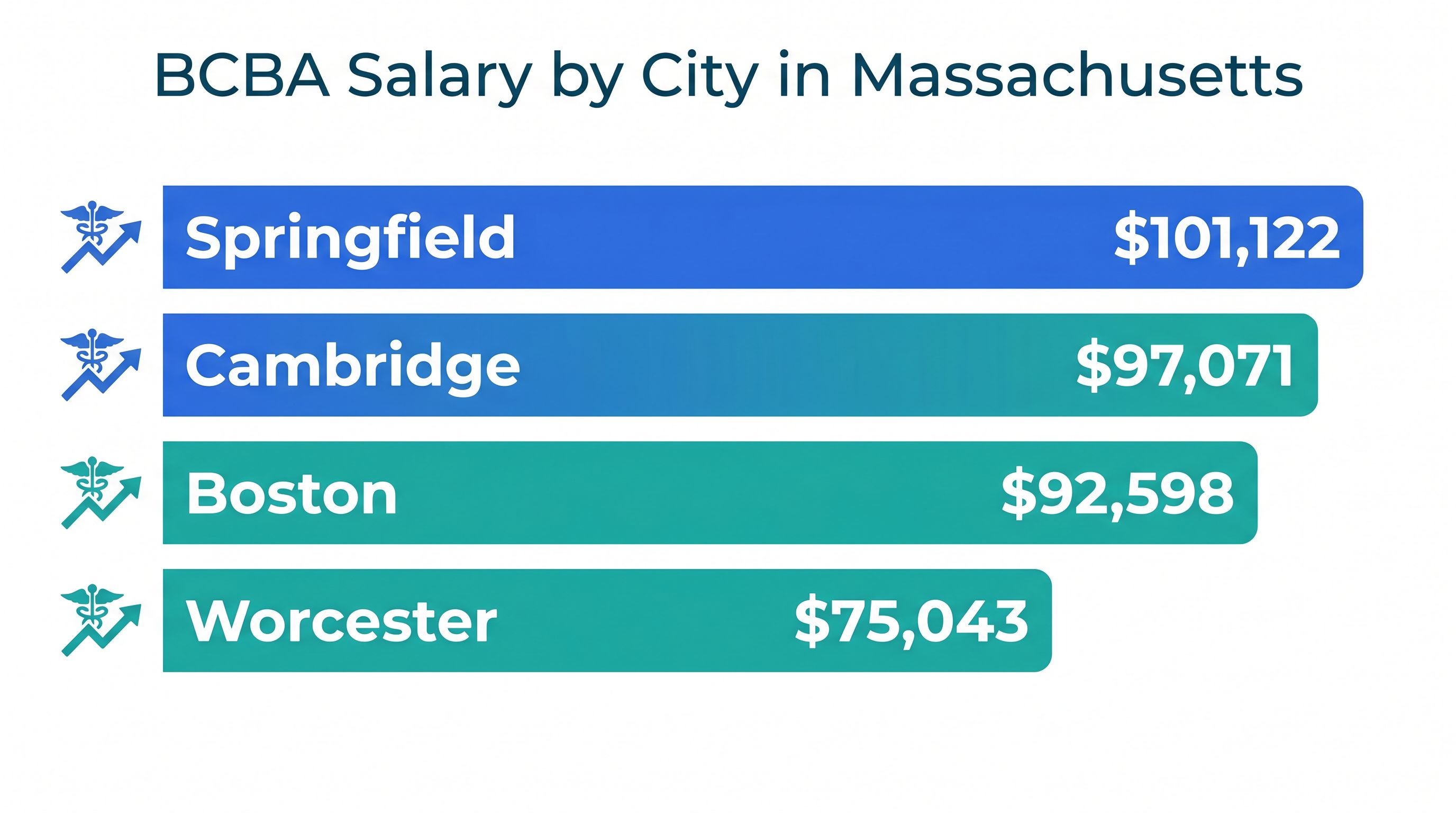 \n
\n Springfield leading the state at $101,122 is not a fluke. Western Massachusetts has fewer BCBAs relative to demand, and school districts in the region compete aggressively for certified professionals. When supply is thin, salaries rise; it is basic economics applied to a credentialed workforce.
Boston, while showing a lower Indeed average, offers the largest volume of positions. Salary.com data puts Boston-area BCBA salaries at $103,040, with the 75th percentile reaching $128,164. The metro area employs roughly 10,980 behavioral health professionals according to BLS data, making it by far the state's largest employment hub.
Worcester sits lower at $75,043, but the significantly lower cost of living in central Massachusetts means your dollar goes further there than in the Boston metro.
BCBA Salary in Massachusetts by Experience Level
Experience is the single biggest factor in BCBA compensation. Here is what to expect at each career stage in Massachusetts:
| Experience Level | MA Salary Range |
|---|---|
| Entry-Level (0-2 years) | $70,000 - $85,000 |
| Mid-Career (3-5 years) | $85,000 - $100,000 |
| Senior / Clinical Supervisor (5-10 years) | $100,000 - $130,000 |
| Clinical Director (10+ years) | $115,000 - $145,000+ |
Entry-level BCBAs in Massachusetts start well above the $66,000 national entry average. The state's strong insurance mandate and high employer demand mean that even newly certified BCBAs have negotiating leverage.
The biggest salary jumps come at two points: moving from individual contributor to clinical supervisor (typically around year 3-5), and stepping into a clinical director or multi-site leadership role. Both transitions commonly add $15,000-$25,000 to annual compensation.
Specializations can also boost earning potential. BCBAs who focus on areas like organizational behavior management, feeding disorders, or school-based consultation often command premium rates, particularly in the Boston metro where specialized roles are more common.
Why Massachusetts BCBAs Earn More
Four factors converge to push Massachusetts BCBA salaries above the national average.
The ARICA Law: One of the Strongest ABA Mandates in the Country
In 2010, Massachusetts passed the Act Relative to Insurance Coverage for Autism (ARICA), requiring private insurers to cover ABA therapy with no age, cost, or hour caps. Massachusetts is one of the few states without any of these limitations. When the Autism Omnibus Bill followed in 2014, MassHealth began covering ABA services in 2015, expanding the payer pool even further.
The result: more funding for ABA services means more demand for BCBAs, which means higher salaries.
A Persistent Supply-Demand Gap
Nationally, there were 132,307 BCBA job postings in 2025 but only 83,586 active BCBAs; that is roughly 1.8 open positions for every certified professional. Massachusetts ranks as a top-four demand state alongside California, New Jersey, Texas, and North Carolina, with these five states accounting for 38% of all postings.
Even with the nation's highest BCBA density, Massachusetts still has more than 570 open positions at any given time. When even the most saturated market cannot fill its roles, you know the shortage is structural.
Cost of Living
Boston's cost of living runs 48-53% above the national average, with housing costs 121% higher. Employers must offer premium compensation just to attract and retain talent in the metro area. This is partly why western Massachusetts cities like Springfield can offer comparable or higher salaries; they compete with the Boston market while offering a lower cost of living, creating strong real-dollar value for BCBAs willing to look beyond the I-95 corridor.
Academic Infrastructure
Massachusetts is home to several top behavior analysis programs, including programs at Northeastern University, Simmons University, and UMass. This creates a well-educated local talent pool, but also a competitive hiring environment where employers must differentiate through compensation and benefits to attract graduates who have options.
The Massachusetts BCBA Employment Gap
The numbers tell a clear story. As of April 2026, the BACB reports 83,586 BCBAs nationally. Industry analysis estimates the country would need approximately five times that number to meet the demand for autism services alone. Massachusetts, despite leading in BCBA density, is no exception to this shortage.
What does this mean for your career? You have leverage. Multiple competing offers, signing bonuses, relocation packages, and flexible scheduling arrangements are increasingly common in the Massachusetts market. BCBAs who understand this dynamic can negotiate from a position of strength.
"Massachusetts has 55.1 BCBAs per 100,000 residents, the highest in the nation, yet still cannot fill its open positions. That is the definition of a structural shortage."
How to Maximize Your BCBA Salary in Massachusetts
With the market firmly in your favor, here are practical ways to earn at the top of the range:
- ✓ Negotiate with data. With 570+ open positions statewide, you are not competing against a flood of applicants. Use the salary ranges in this article and ask for the 75th percentile as your starting point.
- ✓ Consider western Massachusetts. Springfield pays $101,122 on average with a significantly lower cost of living than Boston. Your real purchasing power may be higher outside the metro.
- ✓ Stack credentials. Add state licenses in neighboring states like Connecticut, New Hampshire, or Rhode Island to expand your telehealth reach and make yourself more valuable to multi-state employers.
- ✓ Pursue leadership roles. Clinical director positions in Massachusetts pay $115,000-$145,000+. If you are at the mid-career stage, actively seek supervisory experience to position yourself for these roles.
- ✓ Evaluate total compensation. Base salary is only part of the picture. Signing bonuses, CEU stipends, student loan assistance, health benefits, and flexible schedules all have real dollar value. A $90,000 offer with a $5,000 signing bonus and full CEU coverage may beat a $95,000 offer with neither.
- ✓ Let employers compete for you. Anonymous job platforms let you receive offers without revealing your identity, so you can compare multiple opportunities on your own terms.
Bottom Line
Massachusetts is one of the best states in the country to be a BCBA. Strong legal protections through the ARICA law, top-tier compensation, and abundant job openings create a market where behavior analysts have real choices and genuine leverage.
Whether you are a newly certified BCBA exploring your options or a seasoned clinical director evaluating a move, the Massachusetts market is firmly in your favor. The employment gap is structural, and it is not closing anytime soon.
See What Massachusetts Employers Are Offering
Create a free, anonymous profile on CertifyndABA and let Massachusetts employers come to you with real salary offers. No job applications, no resume blasts; just verified opportunities from employers who know what you are worth.
Create Your Free ProfileHiring BCBAs in Massachusetts? Post transparent salary ranges →