


The most powerful behavior change in ABA often happens before the behavior occurs, not after it. While reinforcement and extinction get most of the attention, seasoned BCBAs know that a well-designed antecedent intervention can prevent challenging behavior from happening in the first place; no consequence needed.
Antecedent interventions in ABA are proactive strategies that modify the events, environments, and establishing operations that precede a behavior. They reduce the motivation for challenging behavior, support the discriminative stimuli for appropriate responses, and are often the least-restrictive option available to a clinician. The Autism Focused Intervention Resources and Modules (AFIRM) program at UNC-Chapel Hill classifies antecedent-based interventions (ABI) as an established evidence-based practice for individuals aged 0 to 22, and the approach is codified in Section D of the BACB's RBT Task List.
This guide covers every major antecedent intervention used in ABA, a function-based decision framework that links each intervention to findings from a functional behavior assessment, a six-step implementation process, data collection standards, ethical considerations under the BACB Ethics Code, and how to combine ABIs with reinforcement-based procedures in a comprehensive behavior intervention plan.
What Are Antecedent-Based Interventions?
The AFIRM team at the Frank Porter Graham Child Development Institute defines antecedent-based interventions as "the arrangement of events or circumstances that precede an activity or demand in order to increase the occurrence of a behavior or lead to the reduction of the interfering behaviors." In simpler terms, ABIs change what happens before a behavior to shape what happens during and after.
Every behavior occurs within a three-term contingency: antecedent (A), behavior (B), consequence (C). Most ABA interventions focus on the consequence side of that equation through reinforcement, extinction, or punishment procedures. Antecedent interventions target the other end. They modify the antecedent conditions so that the desired behavior is more likely to occur, the problem behavior is less likely to occur, or both.
ABIs work through two behavioral mechanisms identified in the behavior-analytic literature:
- Motivating operations (MOs): Interventions that change the value of a reinforcer, typically by abolishing (reducing) its effectiveness. For example, providing frequent attention reduces the value of attention as a reinforcer for attention-seeking behavior.
- Stimulus control: Interventions that establish specific antecedent stimuli as discriminative for appropriate behavior, or that remove stimuli that have been paired with challenging behavior.
Because ABIs are often the least-restrictive intervention available, they align directly with BACB Ethics Code 2.14 (Selecting, Designing, and Implementing Behavior-Change Interventions), which requires behavior analysts to choose evidence-based interventions that minimize risk and respect client autonomy.
Two Categories of Antecedent Interventions
Before looking at individual strategies, it helps to understand a clinical distinction that appears on the BCBA 6th Edition Task List and separates advanced practitioners from beginners.
Contingency-dependent antecedent interventions require the learner to emit a response before reinforcement is delivered. Prompting, modeling, and high-probability request sequences fall into this category. The antecedent sets the stage for the response, but the behavior-reinforcement contingency still applies.
Contingency-independent antecedent interventions deliver the reinforcer (or remove the aversive) on a time-based schedule regardless of what the learner does. Noncontingent reinforcement (NCR), scheduled escape breaks, and environmental enrichment fall into this category. These interventions alter motivating operations directly.
Why this distinction matters clinically: contingency-independent ABIs are often the preferred choice when a behavior is dangerous, when extinction is contraindicated, or when rapid behavior reduction is needed to keep a learner safe. Contingency-dependent ABIs are better suited to skill-building contexts where you want to teach a new response.
| Feature | Contingency-Dependent | Contingency-Independent |
|---|---|---|
| Mechanism | Signal reinforcement availability | Alter motivating operations |
| Contingency role | Essential to outcome | Irrelevant to outcome |
| Examples | Prompting, modeling, high-p sequence | NCR, scheduled breaks, environmental enrichment |
| Best for | Skill acquisition, compliance | Safety-critical behavior reduction |
The 8 Core Antecedent Interventions in ABA
These are the strategies you will encounter most often on the BCBA exam, in the BACB Task List, and in day-to-day clinical practice. Each section below covers how the intervention works, a clinical example, and when to use it.
1. Noncontingent Reinforcement (NCR)
NCR delivers a reinforcer on a fixed-time or variable-time schedule regardless of the learner's behavior. If an FBA reveals that a learner's aggression is maintained by attention, scheduled attention every two minutes can reduce aggression by abolishing the motivating operation for it.
Clinical example: A seven-year-old engages in property destruction to access an iPad (tangible function). NCR delivers 3 minutes of iPad access every 10 minutes on a fixed schedule. Property destruction drops because the iPad is already freely available.
When to use: Dangerous or high-rate problem behavior, when extinction is unsafe, or when a rapid reduction is needed. Plan a fading schedule from the start to avoid dependence.
2. High-Probability Request Sequence (Behavioral Momentum)
Deliver three to five high-probability (high-p) requests that the learner typically complies with, then deliver the low-probability (low-p) target request. The compliance momentum carries over and increases the likelihood of completing the difficult task.
Clinical example: Before asking a learner to brush teeth (a low-p demand), the RBT asks "Give me five," "Clap your hands," "Touch your nose," reinforcing compliance after each. Then: "Brush your teeth." Compliance with toothbrushing increases.
When to use: Compliance problems, transitions, and task initiation with escape-maintained behavior.
3. Environmental Modifications
Changes to the physical setting, including layout, sensory input, lighting, noise, seating, and materials. These are often the simplest ABIs but require systematic observation to identify which environmental features matter.
Clinical example: A learner with sensory sensitivities engages in elopement during group activities. Moving the activity to a quieter room with fewer visual distractions reduces elopement by removing the aversive setting event.
When to use: When ABC data points to specific environmental triggers, or when setting events (noise, crowding, lighting) reliably precede challenging behavior.
4. Visual Supports
First-then boards, visual schedules, cue cards, token boards, and social stories that provide predictable information about expectations and upcoming events. Visual supports reduce uncertainty and can establish powerful discriminative stimuli for appropriate behavior.
Clinical example: A learner becomes distressed during transitions. A visual schedule showing "Math, Break, Reading, Lunch" lets the learner preview the sequence and reduces transition-related tantrums.
When to use: Learners with language or processing needs, high-uncertainty environments, and multi-step routines. Pair with fading procedures to support long-term independence.
5. Priming
Advance preview of an upcoming task, material, or transition. Priming reduces the novelty effect and lowers the motivation for escape behavior by familiarizing the learner with what is coming.
Clinical example: A learner resists starting new academic work. Before the session, the BCBA shows the learner the worksheet and briefly walks through the first two problems. When the actual session begins, the learner starts with less resistance.
When to use: Novel tasks, transitions to demanding activities, new environments, or when escape-maintained behavior is linked to unpredictability.
6. Choice-Making
Offering the learner two or three acceptable options for task order, materials, location, or reinforcer. Choice-making increases autonomy, engagement, and motivation while reducing escape-maintained behavior.
Clinical example: Rather than saying "Do your math now," the BCBA offers: "Do you want to start with addition or subtraction? Do you want to work at the desk or on the beanbag?" The learner engages faster and with less protest.
When to use: Escape-maintained behavior, compliance problems, and any context where learner autonomy can be honored without compromising the program.
7. Demand and Task Modification
Task interspersal (alternating mastered and non-mastered items), demand fading (gradually increasing demand level), and task chunking (breaking complex tasks into smaller steps). These strategies reduce the aversive quality of demands and maintain responding.
Clinical example: A learner resists a 20-step hygiene routine. The BCBA uses task analysis to break it into 20 discrete steps and teaches three at a time, with known easier steps interspersed. Protest behavior drops because the perceived demand is lower.
When to use: Escape-maintained behavior, long or complex tasks, and learners with low task tolerance.
8. Errorless Learning and Antecedent Prompting
Delivering prompts early enough to prevent errors, then systematically fading them. Errorless learning procedures include most-to-least prompting and time delay, both of which minimize error rates during skill acquisition.
Clinical example: Teaching a learner to label new pictures. The BCBA uses a 0-second time delay on the first three trials (say the label immediately after showing the picture) then progresses to 2-second and 4-second delays. The learner acquires the labels with near-zero errors.
When to use: New skill acquisition, learners who become frustrated with errors, and programs where repeated error patterns could inadvertently reinforce incorrect responses.
Function-First: Matching Antecedent Interventions to FBA Findings
Here is where many practitioners stumble. Choosing an antecedent intervention without first identifying the function of the target behavior is the clinical equivalent of prescribing medication without a diagnosis. The FBA identifies what maintains the behavior; the antecedent intervention must target that maintaining variable.
"Selecting antecedent interventions without a function-based rationale is the difference between guessing and practicing behavior analysis."
The four most common behavioral functions and their best-matched antecedent interventions are:
| Behavioral Function | Recommended Antecedent Interventions |
|---|---|
| Attention-maintained | NCR with attention, scheduled attention, proximity priming, visual token boards tied to attention delivery |
| Escape-maintained | Demand fading, task modification, choice-making, high-p sequence, NCR with scheduled breaks, priming |
| Tangible-maintained | NCR with preferred item, visual schedule of item access, priming transitions away from preferred items |
| Automatic/sensory | Environmental enrichment, competing sensory stimuli, altered environmental arrangement |
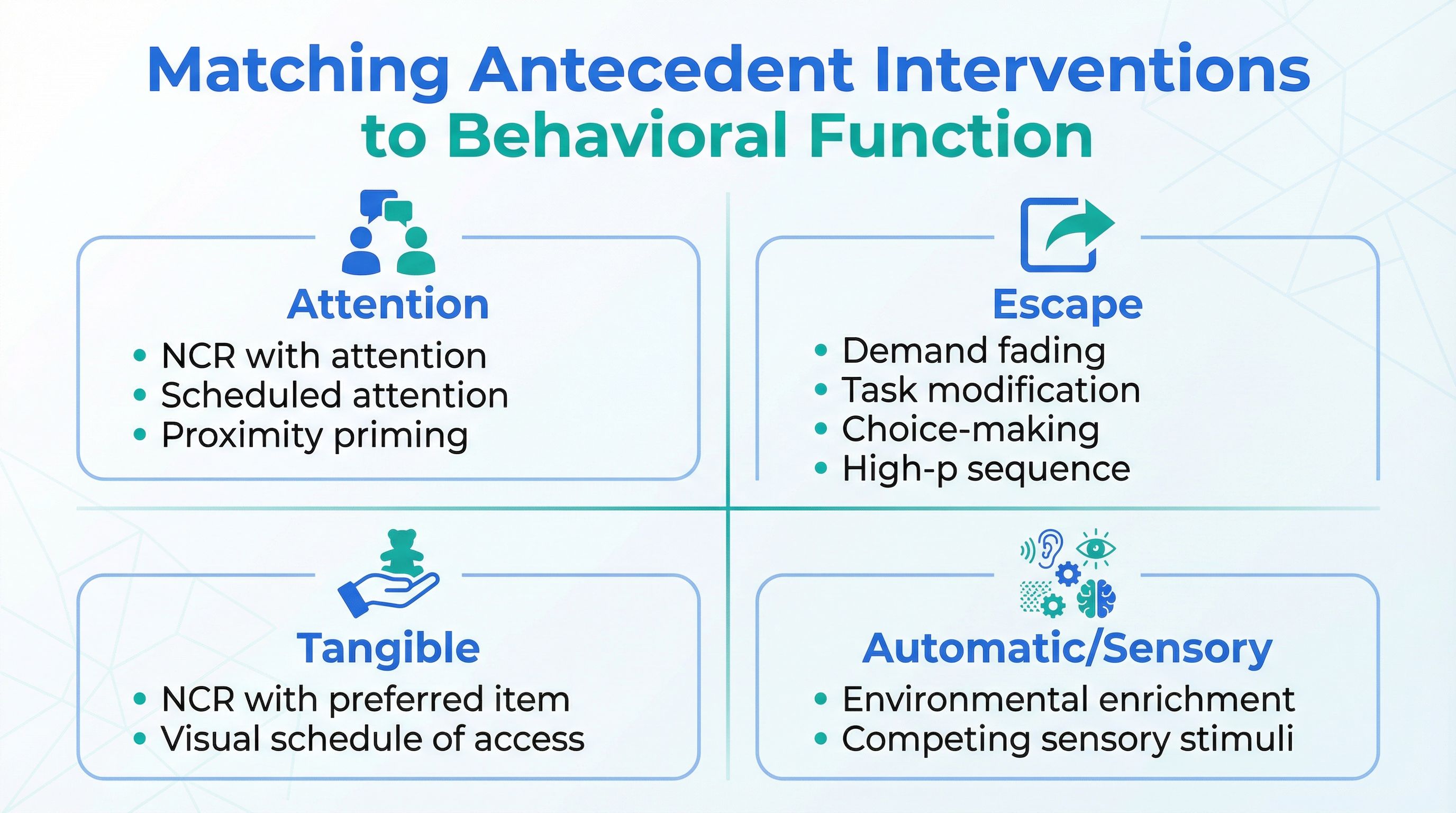
This function-first approach is formalized in the Competing Behavior Pathway model developed by O'Neill and colleagues (1997), which maps setting events, antecedents, problem behavior, maintaining consequences, and replacement behaviors into a single planning framework. When you design a BIP, each section of the pathway should point directly to a function-matched intervention.
Implementing Antecedent Interventions: A 6-Step Process
Good ABI selection fails without good implementation. Use this six-step process every time.
- Complete or review the FBA. Confirm the behavior's function using a combination of indirect assessment, descriptive assessment, and functional analysis as appropriate. The function drives every downstream decision.
- Select one to two ABIs matched to function. Avoid piling on interventions. A focused plan with one well-implemented ABI outperforms a plan with five that nobody can deliver consistently.
- Operationalize the ABIs in the BIP. Define exactly what will be done, when, by whom, and with which materials. Vague instructions become implementation drift.
- Train implementers using behavioral skills training (BST). Explain the intervention, model it, rehearse it with the staff member, and provide performance feedback until they meet a fidelity criterion (typically 80% or higher).
- Collect baseline and ongoing data. Track the target behavior, any replacement behaviors, and implementation fidelity. Without data, you are guessing.
- Evaluate and adjust. Conduct visual analysis of the data after two to three weeks. If the behavior is reducing and replacement behavior is increasing, begin fading the ABI. If not, check fidelity first, then revisit intervention selection.
The single most common reason ABIs fail is implementation drift, not the intervention itself. A well-matched NCR schedule delivered at 40% fidelity will fail; a mediocre intervention delivered at 90% fidelity can succeed.
Data Collection for Antecedent Interventions
Good ABI data answers three questions: Is the target behavior decreasing? Is the replacement behavior increasing? Is the intervention being delivered as designed?
The following data systems are standard:
- Event or frequency recording for discrete target behaviors such as hitting, spitting, or elopement
- Duration recording for variable-length behaviors such as tantrums or engagement periods
- Latency recording for compliance with demands, particularly when measuring high-p sequence effects
- ABC narrative recording to confirm the antecedent-behavior relationship is shifting as intended
- Treatment fidelity checklists with specific observable steps, scored by a second observer at least weekly
Fidelity below 80% is a signal to retrain staff before concluding the intervention does not work. IOA below 80% is a signal that the behavior is not being measured reliably, which means your decisions about intervention effectiveness are built on unreliable data.
Ethical Considerations and BACB Code Compliance
The BACB Ethics Code (2022, effective 2023) directly shapes how antecedent interventions should be selected and delivered.
Code 2.14 (Selecting, Designing, and Implementing Behavior-Change Interventions): Behavior analysts select and design interventions based on an assessment of the client's needs, using evidence-based procedures that minimize risk. Because ABIs are typically less restrictive than consequence-based procedures, they often represent the ethically preferred first option.
Code 2.15 (Minimizing Risk of Behavior-Change Interventions): Behavior analysts must continually evaluate intervention effectiveness and modify the plan when data indicate it is not working. This includes fading ABIs once their purpose is achieved to prevent long-term dependence on environmental accommodations.
Cultural responsiveness: Environmental modifications and visual supports should respect family preferences, language, and cultural context. A visual schedule that uses imagery foreign to a learner's culture can reduce its effectiveness. Involve caregivers in intervention design.
Assent and dignity: Choice-making interventions support learner autonomy, a core principle of ethical ABA practice. Where possible, offer learners meaningful choices within the intervention rather than imposing environmental arrangements without input.
Combining Antecedent Interventions With Other ABA Strategies
ABIs rarely work in isolation. The most effective behavior intervention plans layer antecedent strategies with reinforcement and, where appropriate, mild consequence-based procedures.
ABI + differential reinforcement: Pair antecedent modification with differential reinforcement of alternative (DRA), incompatible (DRI), or other (DRO) behaviors. The ABI reduces the motivation for challenging behavior; the DR procedure builds the replacement behavior.
ABI + extinction: When extinction of the problem behavior is necessary, ABIs reduce the intensity of the extinction burst by lowering baseline motivation. This combination is gentler and often faster than extinction alone.
ABI + skill acquisition programs: ABIs like errorless learning and prompting are woven directly into discrete trial training and naturalistic teaching programs. The antecedent manipulation is the mechanism through which new skills are established.
The Competing Behavior Pathway model provides a structured way to map these combinations onto a single intervention plan. Setting events lead to antecedents, which lead to problem behavior or replacement behavior, which are maintained by consequences. Each arrow in the pathway is a potential intervention point.
Common Mistakes BCBAs and RBTs Make With Antecedent Interventions
These errors appear in case reviews and supervision sessions across the field. Avoiding them separates experienced practitioners from new ones.
- ✕ Selecting ABIs without a completed FBA. Generic strategies applied without function-based rationale are not behavior analysis; they are classroom management.
- ✕ Defaulting to visual supports for every learner. Visual schedules are overused. They are powerful tools for specific profiles but not universal solutions.
- ✕ Failing to fade NCR schedules. Continuous reinforcement at a thick schedule creates dependence. Every NCR plan needs a fading schedule from day one.
- ✕ Skipping implementer training. Telling an RBT or teacher about an intervention in a meeting is not training. Use behavioral skills training and require demonstrated fidelity before implementation begins.
- ✕ Ignoring setting events. Sleep, illness, medication changes, and family stressors dramatically moderate ABI effectiveness. Track them.
- ✕ Treating ABI as a permanent accommodation. Most ABIs should be faded as the replacement behavior strengthens. Permanent dependence is not a successful outcome.
Frequently Asked Questions About Antecedent Interventions
What is the difference between antecedent interventions and consequence-based interventions?
Antecedent interventions change what happens before a behavior to prevent it or make an appropriate behavior more likely. Consequence-based interventions change what happens after a behavior to reinforce, extinguish, or modify it. A comprehensive behavior plan typically uses both; antecedent strategies reduce the likelihood of problem behavior, and consequence strategies build and maintain replacement behaviors.
Can RBTs implement antecedent interventions independently?
RBTs implement antecedent interventions under the supervision of a BCBA, BCaBA, or other qualified supervisor. The BACB Ethics Code and the RBT Task List establish that RBTs deliver interventions designed by the supervising behavior analyst. Section D of the RBT Task List specifically covers behavior reduction procedures, including antecedent-based strategies.
How long does it take to see results from an antecedent intervention?
Well-matched ABIs often produce observable behavior change within 5 to 10 sessions when implemented at high fidelity. Contingency-independent strategies like NCR can show effects within the first session. If you have not seen measurable change after two weeks of high-fidelity implementation, revisit the function hypothesis or the intervention match.
Are antecedent interventions enough on their own, or do you always need consequence procedures?
ABIs can be sufficient in some cases, particularly for mild challenging behavior maintained by a clear function that can be addressed antecedently. For more entrenched behaviors, ABIs are almost always paired with differential reinforcement to build the replacement behavior and, sometimes, extinction to eliminate the problem behavior's reinforcement history.
What is the most effective antecedent intervention?
There is no universally most-effective ABI. The most effective intervention is the one that matches the learner's FBA-identified function, the target behavior, and the available resources. Research on ABIs does not identify a single strategy that outperforms all others; effectiveness depends entirely on appropriate selection and high-fidelity implementation.
How do you document antecedent interventions in a behavior intervention plan?
Document each ABI with the following: the target behavior it addresses, the FBA-identified function it targets, a precise operational description of the intervention, the staff member responsible, the schedule or contingency, the materials required, the fading criteria, and the measurement system. Reference BACB Ethics Code alignment where relevant.
Building Your Antecedent Intervention Toolkit
Antecedent interventions are one of the most powerful tools in the behavior analyst's repertoire. They are evidence-based, often least-restrictive, and aligned with the ethical principles that define the profession. When you select them based on function, implement them with fidelity, and combine them thoughtfully with reinforcement-based procedures, you are practicing behavior analysis at its best.
The difference between an average BCBA and a great one is not the number of techniques they know. It is the precision with which they link each technique to a specific clinical hypothesis and the discipline with which they measure outcomes. Function first. Then intervention. Then data.
Your Clinical Expertise Deserves Visibility
BCBAs and RBTs who design function-based antecedent interventions are exactly the professionals quality employers are searching for. CertifyndABA lets you highlight your specialized clinical skills anonymously so the right employers can find you.
Create Your Free ProfileHiring BCBAs with strong clinical skills? Search by specialized ABA skills →