

You are working with a seven-year-old who cannot brush his teeth independently. He knows how to hold the toothbrush, but the full sequence of steps from squeezing the toothpaste to rinsing his mouth falls apart somewhere in the middle. This is exactly the kind of challenge that task analysis in ABA was designed to solve.
Task analysis is the process of breaking a complex skill into a sequence of smaller, discrete steps that a learner can master one at a time. It is one of the most widely used and well-supported strategies in applied behavior analysis, recognized by the National Professional Development Center on Autism Spectrum Disorders as one of 27 evidence-based practices for children, youth, and young adults with autism. Research shows that task analysis improves outcomes across communication, social skills, motor skills, adaptive behavior, and academics (Steinbrenner et al., 2020).
Whether you are a BCBA designing intervention plans or an RBT implementing them in sessions, understanding how to build, teach, and collect data on task analyses is a foundational clinical skill. This guide covers everything you need: how to create a task analysis, which chaining procedure to use, how to collect data, and practical examples you can adapt for your caseload.
How to Create a Task Analysis
A task analysis is only as good as the steps it contains. Steps that are too broad leave gaps in instruction; steps that are too granular slow the learner down. According to Cooper, Heron, and Heward (2020), there are four established methods for developing a task analysis:
1. Observe a competent performer. Watch someone who can already do the skill and document each step as they perform it. This works well for motor tasks like getting dressed or making a snack.
2. Consult an expert. Ask a specialist, such as an occupational therapist for fine motor tasks or a speech-language pathologist for communication sequences, to validate the steps. This is especially useful for skills outside your primary area of expertise.
3. Perform the task yourself. Complete the task and write down each step as you go. This method often reveals steps that seem obvious but are easy to overlook when observing others.
4. Refine through testing. Start with a draft task analysis, try it with the learner, and adjust based on where breakdowns occur. In practice, most task analyses go through several revisions before they are finalized.
You also need to individualize the task analysis for each learner. Factors that affect step granularity include the learner's current skill level, age, communication abilities, and whether they tend to interpret instructions literally. A task analysis for hand washing might have 8 steps for one learner and 15 for another; neither version is wrong (Indiana Resource Center for Autism, 2020).
Chaining Procedures: Forward, Backward, and Total Task
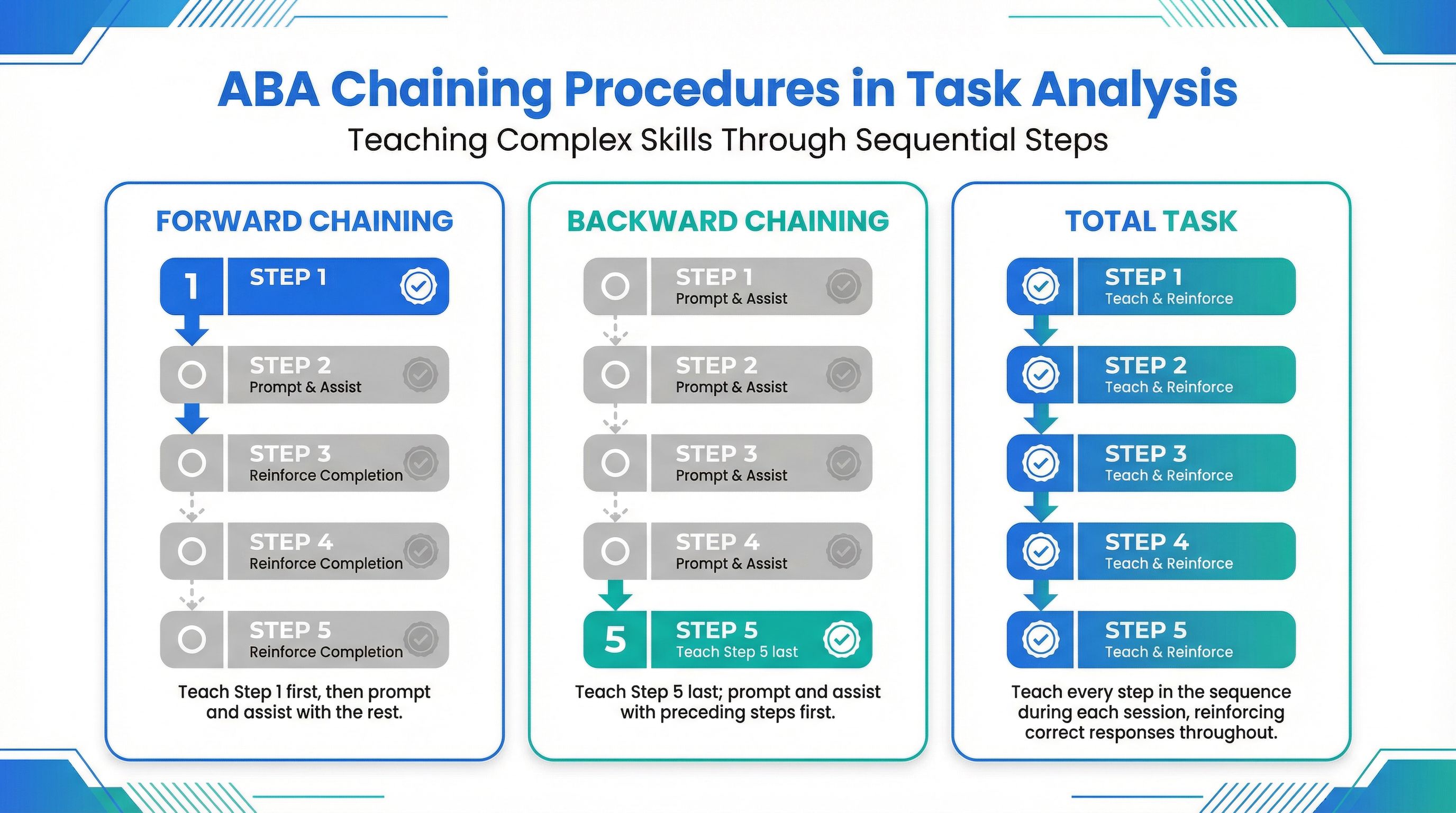
Once you have a task analysis, you need a teaching strategy. In ABA, the three primary approaches for teaching chained behaviors are forward chaining, backward chaining, and total task presentation. Each method uses the same task analysis but differs in which steps the learner performs independently and which steps the instructor completes.
Forward Chaining
In forward chaining, you teach the first step of the task analysis to mastery, then add the second step, then the third, and so on. The instructor completes all remaining steps after the learner finishes their portion.
For example, in a hand-washing task analysis, the learner first masters "turn on the water." Once that step is independent, you teach "turn on the water" and "wet both hands." The learner builds the chain from beginning to end, one link at a time.
Forward chaining follows the natural sequence of the task, which makes it intuitive for many learners. It works particularly well when the early steps of the task are simpler than the later steps.
Backward Chaining
Backward chaining flips the sequence. The instructor performs all steps except the last one, and the learner completes only the final step independently. Once the last step is mastered, the instructor stops at the second-to-last step, and the learner completes the final two steps. The chain builds backward until the learner performs the entire sequence.
The key advantage of backward chaining is that the learner experiences task completion from the very first session. Finishing a task is inherently reinforcing; the learner gets to see the end result every time they practice. This makes backward chaining especially effective for learners who struggle with motivation or who become frustrated during extended teaching sequences.
Total Task Presentation
In total task presentation (also called total task training), the learner attempts every step of the task analysis in each session. The instructor provides prompts as needed at each step but does not complete any steps for the learner. As the learner masters individual steps, prompts are faded until the entire chain is performed independently.
Total task presentation is the most naturalistic of the three approaches. It preserves the flow of the activity and allows the learner to practice the entire routine in context. It works best when the learner already has some steps in their repertoire or when the task is relatively simple.
How to Choose the Right Chaining Method
Selecting between forward chaining, backward chaining, and total task presentation is a clinical decision that depends on the learner, the task, and the teaching context. Here is a practical decision framework:
Choose forward chaining when:
- The early steps of the task are simpler than the later steps
- The learner can attend to the task for sustained periods
- Following the natural sequence of the task supports comprehension
- The learner does not require the reinforcement of immediate task completion
Choose backward chaining when:
- The learner benefits from experiencing task completion immediately
- Motivation is a concern and the finished product serves as a natural reinforcer
- The final steps of the task are easier than the initial steps
- The learner has a history of giving up before completing multi-step tasks
Choose total task presentation when:
- The learner already performs some steps independently
- The task is relatively simple (under 10 steps)
- Preserving the natural flow of the activity matters for generalization
- You want to assess baseline performance across all steps simultaneously
No single method is universally superior. Research supports all three as effective, and the best choice depends on the individual learner's profile. If one method is not producing progress after a reasonable trial period, switching to another is a sound clinical decision (Cooper, Heron, & Heward, 2020).
Data Collection for Task Analysis
Systematic data collection is what separates evidence-based ABA practice from informal teaching. For task analyses, there are two primary assessment methods.
Single-Opportunity Method
Present the task and allow the learner to attempt each step in sequence. If the learner fails to perform a step correctly within a set time interval, stop the assessment and record all remaining steps as incorrect. This method is faster to administer but provides less detailed information about which steps the learner can actually perform later in the chain.
Multiple-Opportunity Method
Present the task and allow the learner to attempt each step. If the learner fails a step, the instructor completes that step and then allows the learner to attempt the next one. This continues through every step in the task analysis, giving you a complete picture of independent performance across the entire chain. It takes more time but yields richer data.
For both methods, record the following at each step:
- Independence level: Did the learner complete the step without help?
- Prompt level required: If prompting was needed, what type (verbal, gestural, model, physical)?
- Accuracy: Was the step performed correctly?
Use the data to make decisions: when to move to the next step in a chaining procedure, when to adjust the task analysis itself, and when to try a different chaining method. If you are familiar with functional behavior assessment, you will recognize similar principles of systematic observation and data-driven decision-making at work here.
Task Analysis Examples for Common ABA Goals
The following examples illustrate how task analyses vary by skill domain and learner needs. Adapt the number of steps and level of detail to each individual.
Daily Living: Hand Washing
- Walk to the sink
- Turn on the water
- Wet both hands under the water
- Pick up the soap
- Rub soap between both hands for 20 seconds
- Rinse both hands under the water
- Turn off the water
- Dry hands with a towel
Recommended chaining method: Forward chaining or total task, since most learners find the early steps straightforward.
Self-Care: Brushing Teeth
- Pick up the toothbrush
- Pick up the toothpaste
- Remove the toothpaste cap
- Squeeze a pea-sized amount of toothpaste onto the bristles
- Put the toothpaste down and replace the cap
- Brush the top teeth (front, back, chewing surfaces)
- Brush the bottom teeth (front, back, chewing surfaces)
- Spit toothpaste into the sink
- Fill a cup with water
- Rinse mouth with water and spit
- Rinse the toothbrush under water
- Put the toothbrush away
Recommended chaining method: Backward chaining can work well here; the learner gets to experience the "clean mouth" outcome from session one.
Social Skills: Greeting a Peer
- Look at the person
- Walk toward the person (within conversational distance)
- Say "hi" or wave
- Wait for the person to respond
- Ask a follow-up question ("How are you?" or "What are you doing?")
Recommended chaining method: Total task presentation, since social interactions happen quickly and breaking them into isolated steps feels unnatural.
Academic: Completing a Worksheet
- Take the worksheet out of the folder
- Write your name at the top
- Read the first question
- Write the answer
- Move to the next question
- Repeat steps 3-5 until all questions are answered
- Check your work
- Put the worksheet in the finished folder
Recommended chaining method: Total task with prompting at individual steps, since most learners can perform at least some steps independently.
Best Practices for Implementation
Task analysis does not exist in isolation. It connects to nearly every other ABA procedure, and how you implement it matters as much as how you design it.
Combine with prompting strategies. Pair your task analysis with a prompting hierarchy (least-to-most, most-to-least, or time delay) to support the learner at each step. The prompting method you choose should match the learner's needs and the step's difficulty.
Use consistent language. Every person working with the learner should use the same wording for each step. Inconsistent instructions create confusion, especially for learners who interpret language literally.
Add visual supports when helpful. Visual schedules, picture cues, or video models can supplement verbal instructions. For some learners, a visual checklist of the task analysis steps is enough to promote independence without any verbal prompting.
Pair with reinforcement. Reinforce both step completion and effort. If you are using differential reinforcement, you can deliver stronger reinforcement for independent steps and lighter reinforcement for prompted steps.
Treat the task analysis as a living document. Revise it based on data. If a learner consistently struggles at a particular step, that step may need to be broken into two smaller steps. If a learner breezes through several steps, those steps might be combined. Your behavior intervention plan should reference the current version of any task analyses used as teaching procedures.
Plan for generalization. Once the learner masters the task in one setting, practice it in different environments with different people and different materials. A learner who can wash their hands at the clinic sink also needs to wash their hands at home and at school.
How Task Analysis Connects to Other ABA Procedures
Task analysis is one piece of a larger clinical toolkit. Understanding how it relates to other ABA procedures makes you a more effective practitioner:
- Discrete Trial Training (DTT) teaches isolated skills through structured trials. Task analysis teaches multi-step skills that link together. DTT builds the individual skills; task analysis chains them into functional routines.
- Functional Behavior Assessment (FBA) identifies why a behavior occurs. Task analysis provides the structure for teaching replacement behaviors identified through the FBA process.
- Behavior Intervention Plans (BIPs) often include task analyses as the teaching procedure for replacement skills. When a BIP calls for teaching an alternative behavior, the task analysis defines exactly how that skill will be taught.
- Differential Reinforcement can be layered on top of task analysis to shape performance quality and speed across individual steps.
Strengthen Your Clinical Skills, Advance Your Career
Mastering task analysis is not just about better client outcomes. It is a core competency that appears on both the BCBA and RBT task lists published by the Behavior Analyst Certification Board. Strong clinical skills in areas like task analysis, FBA, and differential reinforcement set you apart in the job market and position you for roles with greater responsibility and compensation.
Highlight Your Specialized ABA Skills
CertifyndABA lets you showcase your clinical expertise to employers who value it. Build a free anonymous profile, list your skills and certifications, and let qualified employers come to you.
Create Your Free ProfileReferences
- Cooper, J.O., Heron, T.E., & Heward, W.L. (2020). Applied Behavior Analysis (3rd ed.). Pearson Education.
- Indiana Resource Center for Autism. (2020). Applied Behavior Analysis: The Role of Task Analysis and Chaining. Indiana University Bloomington.
- National Professional Development Center on ASD. (2016). Task Analysis (TA) EBP Brief Packet. ERIC ED595409.
- Steinbrenner, J.R., Hume, K., Odom, S.L., et al. (2020). Evidence-Based Practices for Children, Youth, and Young Adults with Autism. Journal of Autism and Developmental Disorders, 52, 4013-4032.