

You present the flashcard, give the instruction, and wait. Three seconds pass. Five seconds. The learner looks at you, then at the materials, but does not respond. What you do next; the type of help you provide, how much, and how you plan to remove it; is the essence of prompting in ABA.
Prompting is one of the most frequently used and foundational tools in Applied Behavior Analysis. Cooper, Heron, and Heward define a prompt as "an added stimulus that assists in occasioning a correct response in the presence of the discriminative stimulus." In simpler terms, it is any form of help that increases the likelihood a learner will respond correctly during instruction.
Research supports the power of systematic prompting. Research consistently shows that structured prompting procedures produce significant improvements across communication, social skills, and academic domains. But prompting only works when practitioners understand which types to use, how to organize them in a hierarchy, and how to fade them systematically.
This guide covers all of it: the types of prompts, the prompting hierarchy, the three major prompting strategies (least-to-most, most-to-least, and time delay), prompt fading techniques, and a research-backed framework for choosing the right approach.
Stimulus Prompts vs. Response Prompts
Before looking at individual prompt types, it helps to understand the two broad categories that all prompts fall into.
Response prompts involve the instructor's behavior to guide the learner's response. These include physical guidance, modeling, gestures, and verbal instructions. They are the most commonly used prompts in clinical and educational settings.
Stimulus prompts modify the antecedent materials or environment to make the correct response more obvious. Examples include placing the correct item closer to the learner (positional prompt), highlighting the correct answer in bold, or making the target stimulus larger than the distractors.
Understanding this distinction matters because fading looks different for each category. Response prompts are faded by reducing the instructor's assistance. Stimulus prompts are faded by gradually normalizing the materials until the correct response is no longer highlighted.
Types of Prompts in ABA
There are six primary types of prompts used in ABA, ranging from highly intrusive to minimally intrusive. Here is each type with a definition and practical example.
| Prompt Type | Definition | Example |
|---|---|---|
| Full Physical | Hand-over-hand guidance through the entire response | Guiding a child's hands through each step of hand-washing |
| Partial Physical | Light touch or nudge to initiate the response without completing it | A gentle tap on the elbow to prompt reaching for the soap |
| Model | Demonstrating the target behavior for the learner to imitate | The instructor waves and says "hi" before the learner greets a peer |
| Gestural | Non-verbal cues such as pointing, nodding, or eye gaze | Pointing toward the correct answer in a matching task |
| Verbal | Spoken instructions; can be direct ("Say thank you") or indirect ("What do you say?") | Saying "What comes next?" during a morning routine |
| Visual | Pictures, written words, video models, or visual schedules | A picture schedule showing the steps of getting dressed |
Some frameworks include a seventh type: positional prompts, where the correct item is placed closer to the learner. This is technically a stimulus prompt rather than a response prompt, but it appears frequently in receptive identification and matching programs.
A few important notes on prompt selection. Model prompts require the learner to have imitation skills as a prerequisite. Verbal prompts are among the most commonly used but are also among the hardest to fade, particularly with young children. Visual prompts are often the easiest to fade and can support long-term independence through tools like visual schedules.
The Prompting Hierarchy: From Most to Least Intrusive
The prompting hierarchy organizes prompt types by their level of intrusiveness, meaning how much control each prompt exerts over the learner's response.
From most intrusive to least intrusive, the standard hierarchy is:
- Full physical prompt (most control over the response)
- Partial physical prompt
- Model prompt
- Gestural prompt
- Verbal prompt
- Visual/positional prompt (least control over the response)
The exact ordering can vary by source and clinical context. Some practitioners place verbal prompts above gestural prompts, arguing that a spoken instruction provides more information than a point. The important principle is not memorizing a fixed sequence; it is understanding that prompts exist on a continuum of intrusiveness and that you should always aim for the least intrusive prompt that produces a correct response.
"The goal of prompting is not to get the right answer. It is to get the right answer with the least amount of help, so that help can be removed."
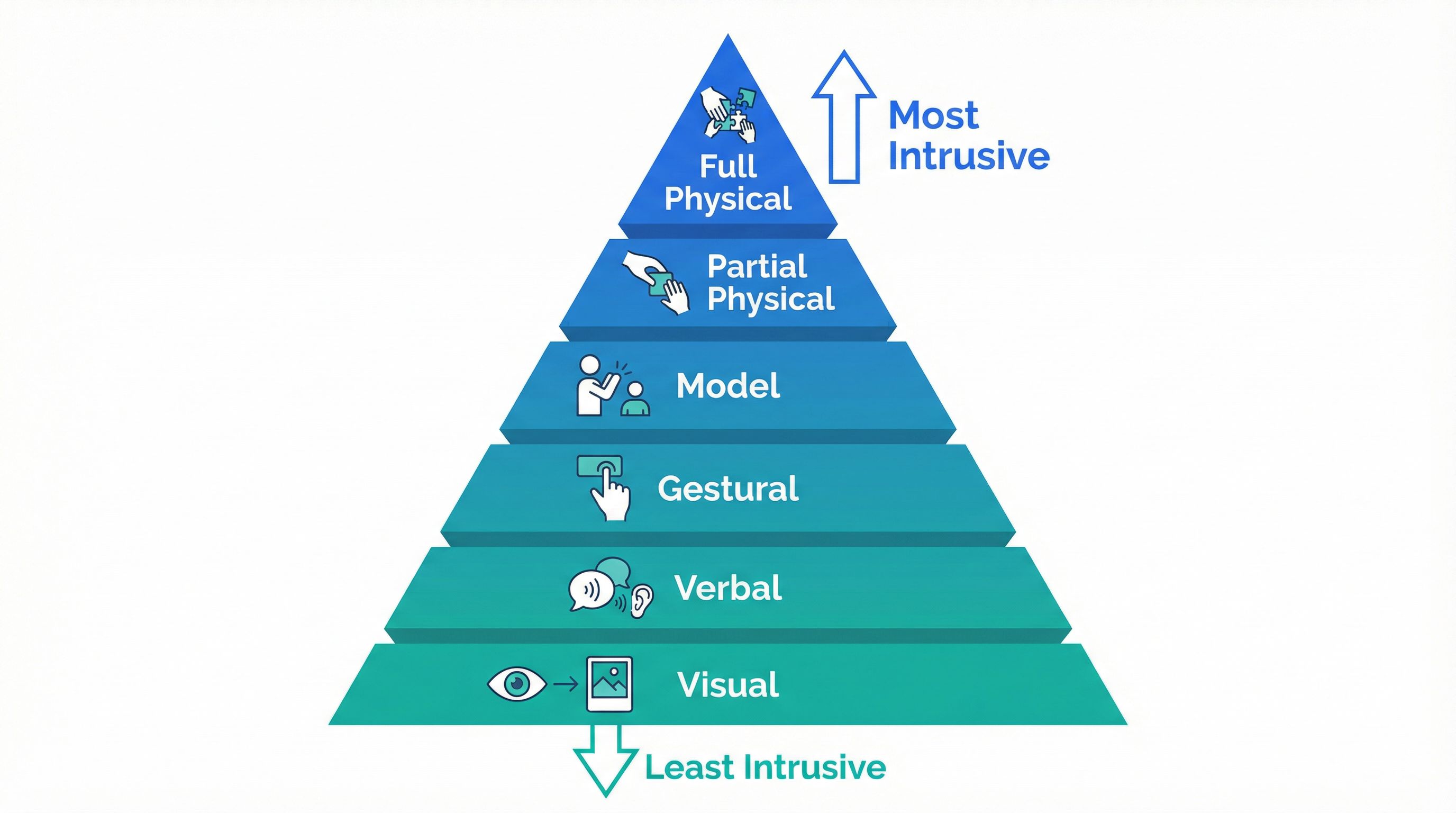
This hierarchy serves as the foundation for the three major prompting strategies: least-to-most, most-to-least, and time delay. Each strategy uses the hierarchy differently to teach new skills while planning for independence from the start.
Least-to-Most Prompting (System of Least Prompts)
Least-to-most prompting starts at the bottom of the hierarchy and works upward. The learner is always given the opportunity to respond with the least amount of help before more intrusive prompts are introduced.
How it works:
- Present the discriminative stimulus (SD) and wait a set interval (typically 3 to 5 seconds)
- If the learner responds correctly, reinforce immediately
- If the learner does not respond or responds incorrectly, provide the next prompt level up the hierarchy
- Wait again, then escalate if needed
- Continue until a correct response occurs, then reinforce
Example: Teaching a child to request a preferred item. You place the item in view (natural cue) and wait. No response after 5 seconds, so you ask "What do you want?" (indirect verbal). Still no response, so you model "I want crackers" (model prompt). The child imitates, and you reinforce with the crackers and praise.
When to use it: Least-to-most prompting works well when the learner has some emerging independence with the skill and can tolerate occasional errors. It maximizes opportunities for independent responding at every trial. Collins, Lo, Park, and Haughney (2018) identified the system of least prompts as one of six evidence-based response-prompting procedures in their systematic review published in TEACHING Exceptional Children.
Watch out for: Learners who become frustrated by errors may not respond well to this approach, since they will inevitably make mistakes at lower prompt levels before receiving sufficient help.
Most-to-Least Prompting and Errorless Learning
Most-to-least prompting takes the opposite approach. It starts at the top of the hierarchy with the most intrusive prompt and systematically reduces support as the learner demonstrates competence.
How it works:
- Present the SD paired with a full physical prompt to ensure a correct response
- Reinforce the prompted correct response
- After a set number of correct trials at the current prompt level (often 3 to 5 consecutive), reduce to the next less intrusive prompt
- Continue fading across sessions until the learner responds independently
This approach is closely associated with errorless learning. By starting with enough support to guarantee success, the learner rarely or never makes errors during skill acquisition. This builds positive momentum and avoids reinforcing incorrect responses.
Example: Teaching hand-washing using task analysis. For each step, you start with full physical guidance. Once the learner completes that step correctly for 5 consecutive sessions with full physical prompts, you fade to partial physical. Then to a model. Then to a gesture. Then to independent performance.
When to use it: Most-to-least prompting is ideal for brand-new skills, complex motor tasks, and learners who become upset or engage in escape behaviors when they make mistakes. It is also a strong choice when you need high success rates to maintain the learner's motivation.
Watch out for: The main risk is prompt dependency. If fading criteria are not clearly defined or if staff are inconsistent, the learner may become reliant on high levels of support. Always establish data-based fading criteria before you begin.
Time Delay Prompting
Time delay is a prompting strategy that inserts a waiting period between the SD and the prompt, giving the learner a window to respond independently before help arrives.
There are two variations:
Constant time delay: The delay between the SD and the prompt stays the same across all trials (for example, always 5 seconds). This is straightforward to implement and easy for staff to learn.
Progressive time delay: The delay starts at 0 seconds and gradually increases. In the first sessions, the prompt is delivered immediately after the SD (0-second delay). Then it increases to 2 seconds, then 4, then 6, and so on. This approach bridges errorless learning and independent responding; early trials are error-free because the prompt comes instantly, and later trials give the learner progressively more time to respond on their own.
Example: Teaching sight words. You show the word card and say "What word?" In the first phase, you immediately model the word (0-second delay). In the next phase, you wait 3 seconds before modeling. If the learner reads the word before the prompt, that is an unprompted correct response; you reinforce heavily. If the learner waits for the prompt, you reinforce more mildly and continue.
Collins et al. (2018) identified both progressive and constant time delay as evidence-based prompting procedures. Time delay is particularly effective for discrete skills like labeling, reading words, and answering factual questions.
Prompt Fading: The Key to Building Independence
Prompt fading is the systematic reduction of prompts to transfer stimulus control from the prompt back to the natural discriminative stimulus. Without fading, even the most effective prompting strategy will fail; the learner will perform the skill only when prompted, which is not true independence.
How to fade each prompt type:
- Physical prompts: Reduce the contact point. Move from hand-over-hand to wrist, then elbow, then shoulder, then a light touch, then shadow (hovering without touching), then remove entirely.
- Model prompts: Reduce the completeness of the demonstration. Model the full action, then just the first movement, then nothing.
- Gestural prompts: Reduce the amplitude of the gesture. A full point becomes a brief finger movement, then an eye glance, then nothing.
- Verbal prompts: Reduce specificity. "Say thank you" becomes "What do you say?" becomes a brief expectant pause. Verbal prompts are notoriously difficult to fade, so plan the fading sequence in advance.
- Visual prompts: Remove elements gradually. A full picture schedule becomes a partial schedule, then a single visual cue, then removal.
Signs the learner is ready for fading:
- Consistent correct responding at the current prompt level (typically 80% or higher across multiple sessions)
- Response latency is decreasing (the learner responds more quickly)
- Anticipatory responses appear (the learner begins the behavior before the prompt is delivered)
Common mistakes: Fading too quickly leads to error spikes and frustration. Fading too slowly builds dependency. Inconsistent fading across different staff members undermines the entire process. The solution to all three is systematic data collection; track the prompt level used on every trial so you can see patterns and make informed decisions about when to fade.
How to Choose the Right Prompting Strategy
With multiple strategies available, how do you decide which one to use? Cowan, Soluaga, and colleagues (2022) published the SWEEPS (Systematic Worksheet for the Evaluation of Effective Prompting Strategies) in Behavior Analysis in Practice to address exactly this question.
The SWEEPS framework evaluates three categories of factors:
Client characteristics:
- Learning speed (fast vs. slow acquisition)
- Tolerance for errors (frustration, escape behaviors)
- Motor imitation abilities (can the learner copy a demonstration?)
- Tolerance of physical contact
Skill characteristics:
- Motor difficulty (fine motor vs. gross motor vs. verbal)
- Novelty (brand new vs. partially acquired)
- Complexity (single-step vs. chained)
Environment factors:
- Setting (clinic, school, home)
- Staff training level and consistency
- Feasibility of implementing specific prompt types
As a practical starting point:
- ✓ New learner + complex skill = most-to-least prompting (errorless learning)
- ✓ Emerging skill + some independence = least-to-most prompting
- ✓ Learner is close to independent = time delay
- ✓ Chained tasks = different prompt levels per step, tracked through task analysis data
Remember that no single strategy is universally best. Monitor prompt-level data across sessions, and be willing to change strategies if the data shows stalled progress, rising error rates, or emerging prompt dependency. A functional behavior assessment can also inform your choice; if the learner's errors are followed by escape or avoidance, an errorless approach may be essential.
Frequently Asked Questions About Prompting in ABA
What are the 5 types of prompting in ABA?
The five most commonly cited prompt types are physical, model, gestural, verbal, and visual. Some frameworks expand this to six by splitting physical prompts into full physical and partial physical, or by adding positional prompts as a separate category.
What is 3-step prompting in ABA?
Three-step prompting is a simplified least-to-most sequence commonly used in classroom and home settings. It follows three levels: (1) verbal prompt, (2) model prompt, (3) physical prompt. If the learner does not respond to the verbal prompt, you model the behavior. If they still do not respond, you provide physical guidance. This streamlined approach is easier for parents and teachers to implement consistently.
How do you prevent prompt dependency?
The best defense against prompt dependency is a fading plan established before instruction begins. Define clear, data-based criteria for reducing prompt levels (for example, "fade after 4 consecutive correct trials at this level"). Track prompt levels on every trial. Train all staff to wait the full delay interval before prompting, and to use the least intrusive prompt that produces a correct response.
What is the difference between a prompt and a cue?
In ABA, a prompt is an added stimulus designed to occasion a correct response. A cue is typically a naturally occurring stimulus that signals an opportunity to respond. For example, someone extending their hand is a natural cue for a handshake; saying "shake their hand" is a prompt. The goal of prompting is always to transfer control to the natural cue so the prompt is no longer needed.
Mastering Prompting: A Core Skill for Every ABA Professional
Prompting is not just one technique among many. It is the mechanism through which most skill acquisition happens in ABA. Whether you are running discrete trial training, implementing a behavior intervention plan, or teaching a new skill through natural environment training, your ability to select, deliver, and fade prompts effectively determines how quickly your learners gain independence.
The difference between a good practitioner and a great one often comes down to the details: choosing least-to-most when the data supports it, recognizing when to switch to errorless learning, fading gestural prompts with intention rather than habit, and tracking prompt levels with the same rigor you bring to differential reinforcement or extinction procedures.
Master this skill, and you will see the results in your data and in your learners' lives.
Your Clinical Expertise Deserves Visibility
BCBAs and RBTs with strong prompting and skill-acquisition expertise are in high demand. CertifyndABA lets you highlight your specialized clinical skills so employers who value that expertise can find you.
Create Your Free Profile