


Extinction in ABA is one of the most researched and effective behavior-reduction procedures in applied behavior analysis. When a behavior that was previously reinforced no longer produces that reinforcement, the behavior decreases over time. It sounds simple, but implementing extinction correctly requires a thorough understanding of behavioral function, careful planning, and ethical awareness.
Whether you are a BCBA designing a behavior intervention plan or an RBT implementing one under supervision, understanding how extinction works across different behavioral functions is essential to effective, ethical practice. This guide covers the four types of extinction procedures, what to expect during an extinction burst, side effects to monitor, and the ethical guidelines that should shape every clinical decision.
How Extinction Works
Cooper, Heron, and Heward define extinction as "a procedure in which reinforcement of a previously reinforced behavior is discontinued; as a result, the frequency of that behavior decreases in the future" (Applied Behavior Analysis, 3rd ed., 2020). The key word is specific. Extinction does not mean ignoring all behavior. It means identifying the exact reinforcer that maintains a problem behavior and withholding that reinforcer.
This is why a functional behavior assessment (FBA) is a prerequisite. Without knowing why a behavior occurs, you cannot select the correct extinction procedure. Ignoring a behavior maintained by escape, for example, actually reinforces it by providing the escape the individual was seeking.
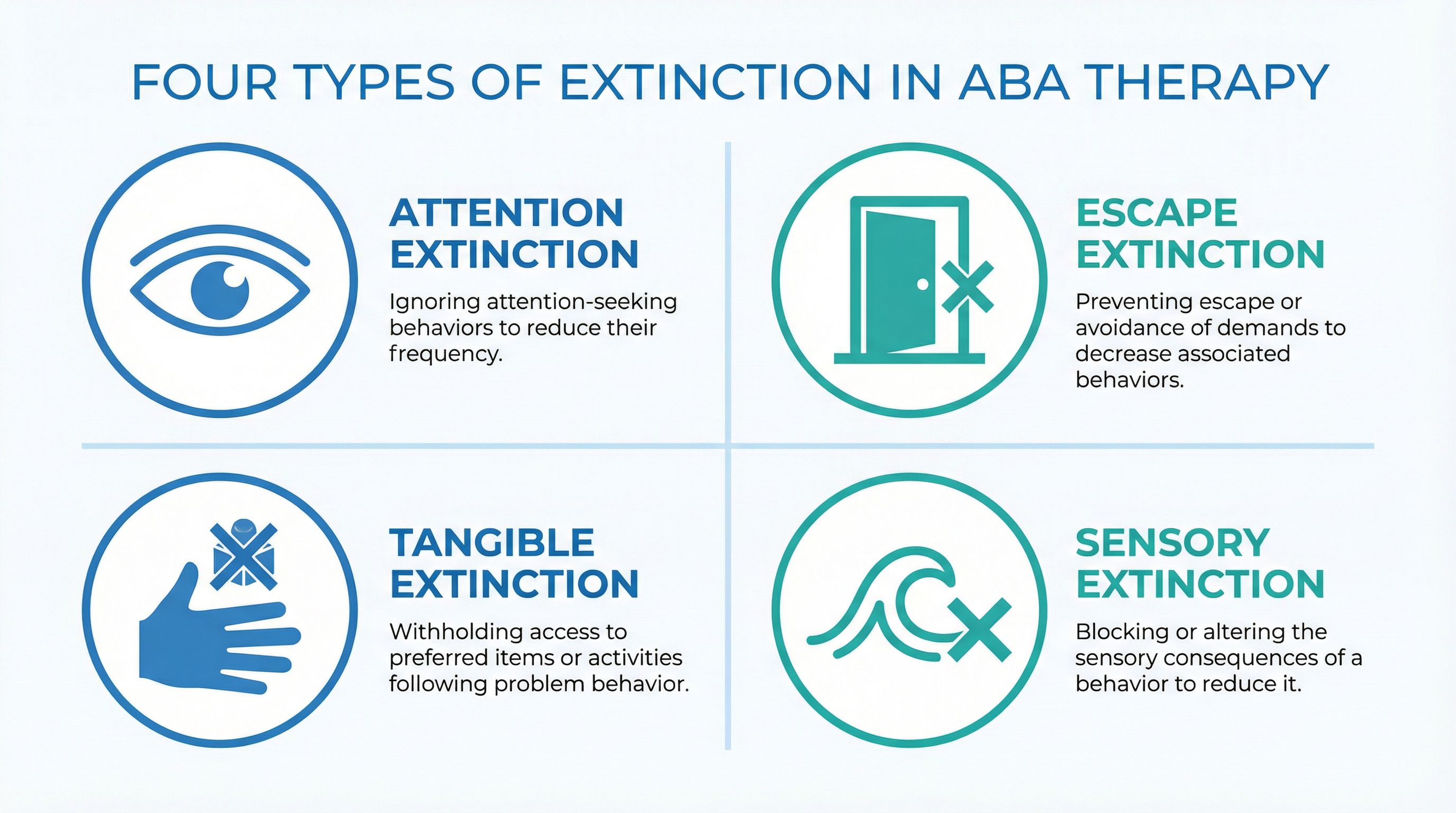
The four functions of behavior are attention, escape/avoidance, access to tangibles, and automatic (sensory) reinforcement. Each function has a corresponding extinction procedure.
Types of Extinction in ABA
Each type of extinction procedure matches a specific behavioral function. Using the wrong procedure can inadvertently reinforce the behavior you are trying to reduce.
Attention Extinction (Planned Ignoring)
When a behavior is maintained by social attention, the extinction procedure involves withholding all attention during the target behavior. This includes eye contact, verbal responses, facial expressions, and physical reactions.
Example: A child screams during group instruction to get the teacher's attention. Under attention extinction, the teacher withholds attention during screaming and provides enthusiastic attention when the child raises their hand or waits quietly.
Consistency is critical. If even one person provides attention during the target behavior, the behavior is now on an intermittent reinforcement schedule, which makes it stronger and more resistant to future extinction attempts. Everyone in the environment must implement the procedure the same way.
Escape Extinction
When a behavior is maintained by escape from demands or aversive situations, the extinction procedure involves continuing to present the demand despite the problem behavior. The individual is not allowed to avoid the task through the target behavior.
Example: A student pushes materials off the desk to avoid completing math worksheets. Under escape extinction, the therapist re-presents the materials and continues the demand, often paired with prompting and modified task difficulty to support success.
Escape extinction is the most ethically sensitive type. It requires careful consideration of assent, bodily autonomy, and whether the demand itself is appropriate and meaningful for the individual. Trauma-informed practitioners assess whether the demand needs modification before deciding that the escape behavior needs reduction.
Tangible Extinction
When a behavior is maintained by access to preferred items or activities, the extinction procedure involves not providing the desired item following the problem behavior.
Example: A child throws tantrums at the store to obtain candy. Under tangible extinction, the parent does not provide candy following the tantrum, while teaching and reinforcing appropriate requesting ("Can I have candy, please?").
Sensory (Automatic) Extinction
When a behavior is maintained by the sensory stimulation it produces, the extinction procedure involves modifying the environment so the behavior no longer produces its reinforcing sensory consequence. This is the most challenging type because the reinforcement is intrinsic to the behavior itself.
Example: A child mouths non-food objects for oral stimulation. Providing a safe, appropriate chewy tube gives access to similar sensory input while reducing mouthing of unsafe items. Alternatively, wearing thin gloves might alter the sensory feedback from hand-mouthing enough to reduce the behavior.
Sensory extinction often requires creative environmental modifications rather than simple withholding of social consequences.
| Function | Extinction Procedure | Example |
|---|---|---|
| Attention | Withhold all social attention during the behavior | Ignore screaming; give attention for hand-raising |
| Escape | Continue presenting demands despite the behavior | Re-present worksheet after materials are thrown |
| Tangible | Do not provide the item following the behavior | No candy after a tantrum; reinforce polite requests |
| Automatic/Sensory | Modify the environment to block sensory reinforcement | Provide a chewy tube to replace mouthing objects |
Understanding the Extinction Burst
When extinction is first implemented, the target behavior often gets worse before it gets better. This temporary increase in frequency, duration, or intensity is called an extinction burst.
A landmark study by Lerman, Iwata, and colleagues found that 62% of individuals (13 of 21) displayed extinction bursts when extinction was implemented alone for self-injurious behavior. A comprehensive review by Fisher, Greer, Shahan, and Norris published in the Journal of Applied Behavior Analysis (2022) confirmed that these bursts typically occur early, often within the first few sessions or even the first minutes of extinction, and resolve quickly.
The Temporally Weighted Matching Law (TWML) offers an explanation: when reinforcement suddenly stops, the relative value of the target behavior temporarily spikes before rapidly declining. Fisher et al. also found that "preventing large decreases in the magnitude of reinforcement should decrease the probability of an extinction burst," suggesting that gradual fading approaches may reduce burst severity.
Understanding the extinction burst is critical for one reason above all others: if a caregiver or practitioner gives in during the burst, they have just reinforced the behavior at a higher intensity. This creates a more resistant behavior pattern than the one they were trying to eliminate.
Other Side Effects of Extinction
Beyond the extinction burst, practitioners should prepare for several additional side effects.
Spontaneous recovery occurs when a previously extinguished behavior reappears after a period of time without reinforcement. The behavior typically returns at reduced intensity. This does not mean the procedure failed. Continue withholding reinforcement and the behavior will decrease again, usually more quickly than the first time.
Resurgence happens when a previously reinforced behavior reappears after a more recently reinforced alternative behavior is placed on extinction. For example, if you teach a replacement behavior (like requesting a break) and then stop reinforcing that replacement, the original problem behavior may resurface.
Extinction-induced aggression refers to emotional responses, including frustration, crying, or aggression, that can occur when reinforcement is withheld. This is especially important to anticipate when working with individuals who engage in self-injurious or aggressive behaviors.
Response variability is a potentially useful side effect. When the usual behavior stops working, the individual may try new behaviors to obtain the reinforcer. Clinicians can use this variability to shape and reinforce appropriate alternative behaviors.
Ethical Considerations and BACB Guidelines
Extinction is a powerful tool, and with that power comes significant ethical responsibility. The BACB Ethics Code provides clear guidance.
Section 2.14 requires that behavior-change interventions align with behavioral principles, have evidence support, and be tailored to the individual client's needs. Extinction procedures must be matched to the assessed function of behavior, not applied generically.
Section 2.15 establishes the least-restrictive treatment principle. Behavior analysts should recommend reinforcement-based procedures whenever possible and ensure that appropriate steps have been taken to implement reinforcement-based procedures before resorting to more restrictive options.
"Extinction should never be implemented in isolation. Always pair it with reinforcement for a functionally equivalent replacement behavior."
Additional ethical requirements include:
- ✓ Informed consent: Caregivers must understand the procedure, the likely extinction burst, the expected timeline, and potential side effects before implementation begins
- ✓ Assent monitoring: Especially with escape extinction, consider the individual's right to withdraw assent and whether the demand itself is appropriate
- ✓ Safety planning: Document safety protocols before implementing extinction for behaviors that could escalate to self-injury or aggression
- ✓ Ongoing data collection: Track frequency, duration, and intensity to make data-driven decisions about continuing, modifying, or discontinuing the procedure
For RBTs, extinction procedures fall under Task List item D-5. RBTs implement these procedures under the direct supervision of a BCBA, who is responsible for designing the intervention and monitoring its effects.
Pairing Extinction With Differential Reinforcement
Extinction should almost never be used alone. Research consistently shows that pairing extinction with differential reinforcement produces faster, more durable behavior change with fewer side effects.
The most common pairings include:
- DRA (Differential Reinforcement of Alternative Behavior): Reinforce a specific alternative behavior that serves the same function. If a child screams for attention, teach and reinforce hand-raising instead.
- DRO (Differential Reinforcement of Other Behavior): Reinforce the absence of the problem behavior for a specified time interval.
- DRI (Differential Reinforcement of Incompatible Behavior): Reinforce a behavior that is physically incompatible with the problem behavior.
Teaching a functionally equivalent replacement behavior is critical. The replacement must be as efficient or more efficient than the problem behavior at accessing the same reinforcer. A child will not use a complex communication system if screaming gets attention faster. The replacement behavior needs to work at least as well, and ideally better, than the behavior you are reducing.
Extinction and differential reinforcement together form the core of most behavior intervention plans (BIPs). The BIP outlines both what to do when the problem behavior occurs (extinction) and what to reinforce instead (the replacement behavior).
Best Practices for Implementing Extinction
- Always start with an FBA. Never assume the function. A behavior that looks like it is maintained by attention may actually be maintained by escape. The functional behavior assessment determines which extinction procedure is appropriate.
- Get team buy-in before starting. Every person who interacts with the individual must implement the procedure consistently. One person reinforcing the behavior undermines the entire intervention.
- Prepare caregivers for the extinction burst. Explain what it is, why it happens, and how long it typically lasts before it occurs. Caregivers who are not prepared are far more likely to give in during the burst.
- Pair with reinforcement from day one. Teach and reinforce the replacement behavior simultaneously. Do not wait until the problem behavior decreases to introduce an alternative.
- Collect data continuously. Track frequency, duration, and intensity across sessions. Data tells you whether the procedure is working, whether a burst is occurring as expected, or whether you need to reassess.
- Plan for spontaneous recovery. When the behavior reappears after a period of absence, it does not mean the procedure failed. Continue the protocol and the behavior will decrease again.
- Have a safety plan. For behaviors involving self-injury or aggression, document specific safety protocols before beginning the extinction procedure. Know exactly what to do if the behavior escalates beyond a manageable level.
- Document everything. Maintain detailed records for BACB compliance, clinical decision-making, and caregiver communication. Documentation should include baseline data, the identified function, the specific procedure, data on progress, and any modifications made.
Frequently Asked Questions
How long does an extinction burst last?
Research by Fisher et al. (2022) shows that extinction bursts typically occur during the first few sessions or even the first few minutes of implementation and resolve quickly. The duration varies based on the individual, the behavior's reinforcement history, and how consistently extinction is applied. A common clinical timeframe is about one to two weeks, though the most intense period is usually the first few days.
Is extinction the same as ignoring?
No. Planned ignoring is one specific type of extinction used only for behaviors maintained by attention. Extinction involves withholding the specific reinforcer that maintains a behavior, which varies depending on the function. For escape-maintained behavior, "extinction" means continuing to present the demand. Ignoring an escape-maintained behavior would actually reinforce it.
Can extinction be harmful?
When implemented without proper assessment, training, and safeguards, extinction can cause distress and potentially worsen behavior patterns. Ethical practice requires conducting an FBA, obtaining informed consent, planning for the extinction burst, pairing with reinforcement, and monitoring for adverse effects. Escape extinction in particular requires careful attention to assent and bodily autonomy.
What if the behavior gets worse during treatment?
An initial increase in the behavior (extinction burst) is expected and actually indicates that the procedure is affecting the reinforcement contingency. The critical response is to maintain consistency. If the team gives in during the burst, the behavior is reinforced at a higher intensity, creating a more resistant pattern.
Should RBTs implement extinction independently?
No. RBTs implement extinction procedures under the supervision of a BCBA, as outlined in the RBT Task List (D-5). The BCBA designs the procedure, trains the RBT on implementation, and monitors the effects. If you are preparing for the RBT certification exam, understanding when and how extinction is used is essential.
Conclusion
Extinction is a powerful, evidence-based procedure when implemented ethically, consistently, and as part of a comprehensive behavior intervention plan. Success depends on four things: an accurate functional behavior assessment, consistent implementation across all team members, pairing with differential reinforcement for replacement behaviors, and thorough preparation of everyone involved.
The professionals who master these procedures do not just reduce problem behaviors. They build the foundation for meaningful skill acquisition and improved quality of life for the individuals they serve.
Highlight Your Clinical Expertise
Employers are looking for ABA professionals with strong clinical skills. Create your free CertifyndABA profile to showcase your expertise in evidence-based procedures and let qualified employers come to you.
Create Your Free Profile