

You've finished your 40-hour training. You understand reinforcement, can explain discrete trial teaching, and you're ready to launch your career as a Registered Behavior Technician. But there's one practical hurdle between you and that certification exam: the RBT competency assessment.
Here's what makes this evaluation different from anything you've done so far—you can't just know the material. You have to demonstrate it. With a qualified assessor watching, you'll perform real procedures, explain your reasoning, and prove you can apply what you've learned with actual clients.
The stakes are real. First-time RBT exam pass rates sit at 73% for 2024, but that number drops to just 36% for retake attempts (BACB, 2024). Thorough preparation for both your competency assessment and certification exam isn't just helpful—it's essential.

This guide breaks down exactly what you'll face during your competency assessment, how to prepare strategically, and what comes after you pass. Whether you're feeling anxious or confident, you'll walk away with a clear action plan.
What Is the RBT Competency Assessment?
The RBT competency assessment is a hands-on practical evaluation that measures your ability to perform essential behavior technician skills. Unlike the written certification exam you'll take later, this assessment requires you to actually demonstrate procedures—not just answer questions about them.
Think of it this way: your 40-hour training taught you the concepts. The competency assessment confirms you can apply them.
You'll need to pass this assessment after completing your training but before you can submit your application for the RBT certification exam. The assessment covers 20 tasks organized across four domains: Measurement, Assessment, Skill Acquisition and Behavior Reduction, and Professionalism.
The critical detail that catches many candidates off guard: you must pass 100% of the tasks. There's no partial credit, no "close enough." Each task gets scored pass or fail, and you need to clear every single one (BACB, 2024).
Most assessments take between 1-3 hours, though there's no formal time limit (CentralReach, 2024). Your assessor wants to see competence, not speed. The evaluation can happen in-person, through live video observation, or via recorded sessions—giving you flexibility in how and where you complete it.
Initial vs. Recertification Competency Assessment
If you're reading this guide, you're likely preparing for your initial competency assessment—the one required to become certified for the first time. This evaluation confirms you've developed the foundational skills needed to work as an RBT.
Current RBTs face a different version: the annual recertification competency assessment. This ongoing evaluation ensures practicing technicians maintain their skills over time, with their supervising BCBA verifying continued proficiency.
However, significant changes are coming in 2026. The BACB is replacing annual recertification assessments with a professional development unit (PDU) system. Instead of yearly competency checks, certified RBTs will complete 12 PDU hours every two years (CentralReach, 2024). More on these changes later.
For now, focus on your initial assessment. Master it once, and you'll have a strong foundation for everything that follows.
The 90-Day Rule You Can't Ignore
Here's a timeline requirement that trips up more candidates than you'd expect: your competency assessment cannot be completed more than 90 days before you submit your RBT application (BACB, 2024).
This means you need to plan carefully. Complete your 40-hour training first—that's non-negotiable. Then schedule your competency assessment with enough buffer time to handle any hiccups, but not so early that you risk exceeding the 90-day window.
The most common mistake? Waiting until after training ends to even start looking for an assessor. By then, you're burning through your window while scrambling to find a qualified BCBA with availability. Start networking for your assessor during training, not after.
The 20 Tasks You Must Demonstrate (Organized by Domain)
The competency assessment evaluates your skills across four domains, with tasks distributed based on how they reflect daily RBT responsibilities. Understanding what each domain covers—and how tasks are assessed—removes much of the mystery.
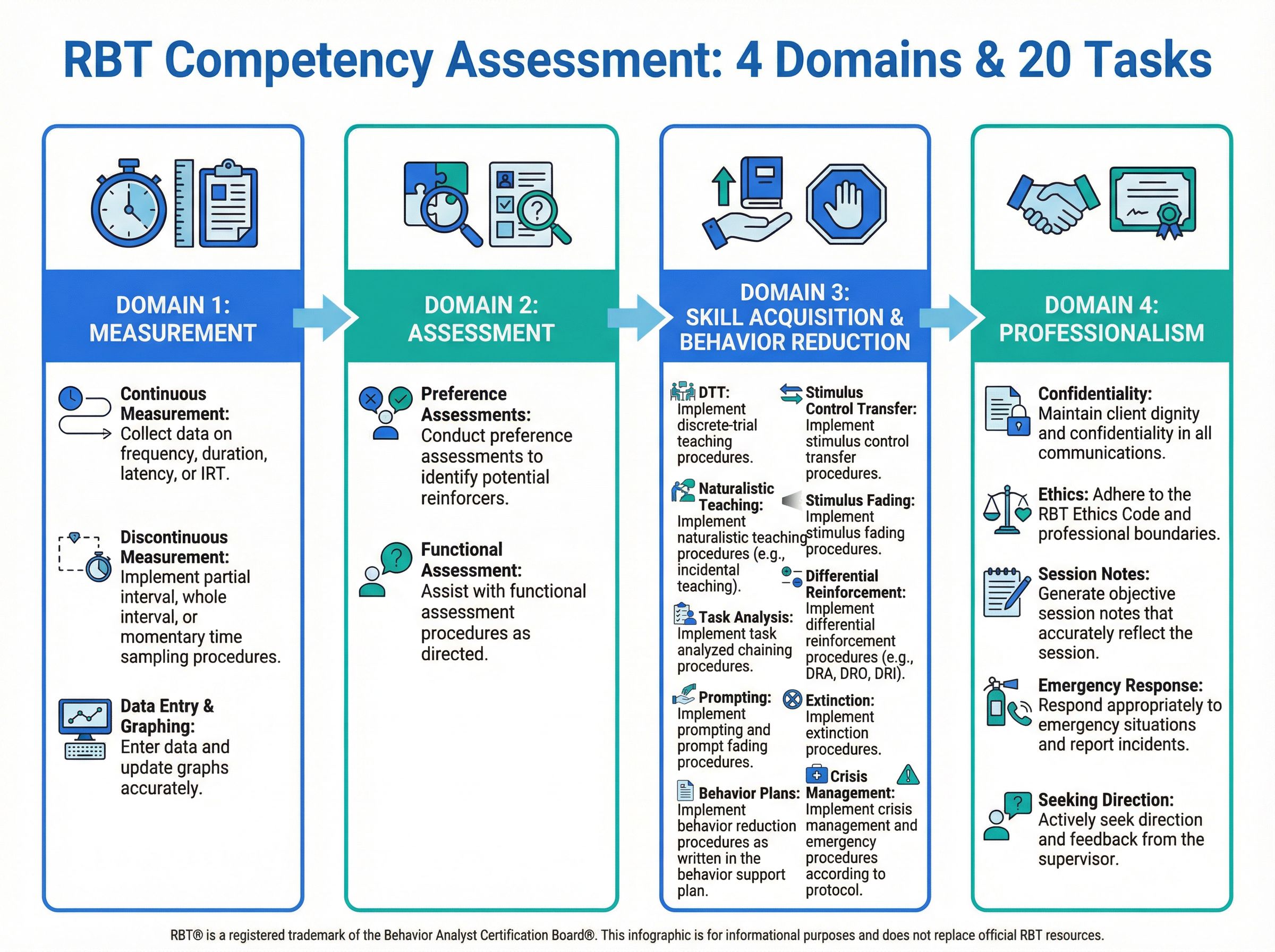
Here's the structural reality: at least three tasks must be demonstrated with actual clients. The remaining tasks can be completed through role-play scenarios or interview questions. You'll need access to a compliant client for those required demonstrations, so coordinate this with your assessor well in advance.
Every task receives a simple pass or fail score. There's no grading curve, no averaging across domains. Miss one task, and you'll need to demonstrate it again before moving forward.
Domain 1: Measurement (3 Tasks)
Measurement forms the backbone of data-driven practice. Without accurate data collection, BCBAs can't make informed treatment decisions, and you can't track client progress.
Task 1: Implement continuous measurement procedures. You'll demonstrate data collection methods that capture every instance of a behavior. This includes frequency counts (how many times a behavior occurs), duration recording (how long it lasts), latency measurement (time from instruction to response), and inter-response time (gaps between behavior occurrences). Know when each method applies—your assessor may ask why you'd choose duration over frequency for a specific behavior.
Task 2: Implement discontinuous measurement procedures. These methods sample behavior rather than capturing every instance. You'll demonstrate partial interval recording (did the behavior occur at any point during the interval?), whole interval recording (did it occur throughout the entire interval?), and momentary time sampling (was it happening at the exact moment the interval ended?). Each serves different purposes depending on behavior characteristics and practical constraints.
Task 3: Enter data and update graphs. Beyond collecting data, you need to accurately record it and contribute to visual analysis. This might involve entering session data into electronic systems or plotting points on behavior graphs.
Practical tip: During assessment, be prepared to explain your measurement choice. Saying "I'm using duration recording because we need to know how long the tantrum lasts, not just how often it occurs" demonstrates understanding that goes beyond rote procedure.
Domain 2: Assessment (2 Tasks)
Assessment tasks focus on gathering information that guides treatment planning. As an RBT, you'll assist with these procedures rather than designing or interpreting them—that's your supervising BCBA's role.
Task 4: Conduct preference assessments. You'll demonstrate at least one method for identifying potential reinforcers. Options include paired stimulus presentations (comparing two items at a time), multiple stimulus with or without replacement (offering several choices), and free operant observations (noting what the client naturally gravitates toward). Know the differences—a multiple stimulus without replacement assessment looks very different from a paired stimulus approach.
Task 5: Assist with functional assessment procedures. This typically means collecting ABC data (Antecedent-Behavior-Consequence) to help identify why a behavior occurs. You observe, you record, you provide accurate information. The BCBA analyzes that data and develops hypotheses about behavior function.
Remember your scope: you're a data collector and implementer, not a diagnostician. Assessors want to see that you understand this boundary.
Domain 3: Skill Acquisition and Behavior Reduction (10 Tasks)
This domain carries the most weight because it reflects the majority of what you'll do every day as an RBT. Expect substantial focus here during your assessment.
Skill acquisition tasks include:
- Discrete Trial Teaching (DTT): Running structured learning trials with clear antecedents, prompts, responses, and consequences. Each trial should have distinct beginning and end points.
- Naturalistic teaching: Embedding instruction within naturally occurring activities and following the client's motivation.
- Task analysis and chaining: Breaking complex skills into teachable steps and linking them together through forward or backward chaining.
- Prompting and prompt fading: Providing assistance to help clients succeed, then systematically reducing that assistance to build independence.
- Shaping: Reinforcing successive approximations toward a target behavior.
- Discrimination training: Teaching clients to respond differently to different stimuli.
Behavior reduction tasks include:
- Implementing behavior intervention plans: Following the BCBA-designed plan with fidelity, including knowing what to do when challenging behaviors occur.
- Token economy systems: Delivering tokens as conditioned reinforcers that can be exchanged for backup reinforcers.
- Antecedent interventions: Modifying the environment to prevent challenging behaviors before they occur.
- Differential reinforcement: Reinforcing appropriate behaviors while withholding reinforcement for problem behaviors.
- Extinction procedures: Consistently withholding reinforcement for previously reinforced behaviors.
- Emergency and crisis procedures: Responding appropriately when safety is at risk, emphasizing de-escalation and least restrictive approaches.
At least three tasks from this domain must be demonstrated with actual clients. Role-play won't suffice for all of them. This requirement exists because some skills simply can't be adequately assessed without real-world application.
During demonstrations, explain your reasoning as you work. "I'm using a physical prompt because the client hasn't responded to the gestural prompt after three trials" shows clinical thinking, not just mechanical procedure following.
Domain 4: Professionalism and Requirements (5 Tasks)
This domain covers ethical conduct and professional behavior—skills that keep you, your clients, and your organization safe.
Client confidentiality and professional boundaries. You'll likely discuss scenarios involving protected health information, social media considerations, and maintaining appropriate relationships with clients and families.
Following ethical guidelines and scope of practice. Know the RBT Ethics Code 2.0. Expect scenario-based questions like "What would you do if a parent asked you to change the treatment plan?" The answer involves understanding your role and when to defer to your supervisor.
Writing objective session notes. This is the only non-interview task in Domain 4. You'll demonstrate that you can document sessions accurately, using objective behavioral language rather than interpretive statements.
Responding to emergency situations. How do you handle medical emergencies? What about challenging behaviors that escalate to safety concerns? Your answers should emphasize client dignity, de-escalation, and following established protocols.
Seeking clinical direction. This means knowing when something is beyond your scope—and actually reaching out to your supervisor rather than improvising solutions.
Most Domain 4 tasks are completed through interview format. Your assessor will present situations and ask how you'd respond. There's often not one "right" answer, but there are clearly wrong ones. Think before responding, and when in doubt, the answer usually involves consulting your BCBA.
Who Can Conduct Your Assessment?
Not just any BCBA can serve as your competency assessor. The BACB has specific requirements that protect both you and the integrity of the credential. Understanding these requirements prevents the frustrating scenario of completing an assessment only to discover it's invalid.
Qualified Assessor Requirements
Your responsible assessor must meet all of the following criteria:
- Hold active BCBA, BCBA-D, or BCaBA certification. Their credential must be in good standing, not expired or suspended.
- Have completed the 8-hour supervision training. This training prepares BCBAs to supervise RBTs and conduct competency assessments properly.
- Not be related to you, subordinate to you, or employed by you. This prevents conflicts of interest that could compromise assessment integrity.
- Be employed at your organization OR have a contractual relationship with your organization. Independent assessors are acceptable if proper agreements exist.
Interestingly, your assessor can be the same person who delivered your 40-hour training. If your training provider is also a qualified BCBA at your organization, that's perfectly acceptable.
For BCaBA assessors, there's an additional layer: their own supervisor must also be connected to the same organization where you're working or training.
Understanding the Assistant Assessor Role
Responsible assessors can delegate portions of the assessment to an assistant assessor. This person doesn't need BACB certification, but they must have demonstrated proficiency in the specific tasks they're assessing—verified through direct observation by the responsible assessor.
The responsible assessor remains professionally accountable for the entire evaluation, regardless of who conducts individual components.
A significant 2026 change: assistant assessors will need to hold at least RBT certification. If you're working with an assistant assessor this year, confirm they meet current requirements.
The same conflict-of-interest rules apply to assistant assessors. They can't be your family member, work for you, or have other relationships that could bias their evaluation.
How to Prepare for the RBT Competency Assessment
Strategic preparation separates candidates who pass confidently from those who struggle. With exam retake pass rates sitting at just 36%, getting it right the first time matters (BACB, 2024).
Review Your 40-Hour Training Materials
Passive consumption of training content won't prepare you for a practical assessment. When you review materials, take active notes. Pause to practice. Teach concepts to someone else.
Focus on understanding the "why" behind each procedure, not just the mechanics. Anyone can memorize "deliver reinforcement immediately after the target behavior." Fewer candidates can explain why timing matters and what happens when it's delayed.
Master the vocabulary that appears throughout ABA: reinforcement, extinction, prompting, stimulus control, replacement behavior, maintaining behavior. Your assessor will use these terms, and you need to both understand them and explain them clearly.
Download two essential documents from the BACB website: the RBT Task List (2nd Edition) and the RBT Handbook. These outline exactly what you're expected to know and do.
Practice with Mock Scenarios and Role-Play

Reading about discrete trial teaching is one thing. Running actual trials—with timing, pacing, prompt delivery, and reinforcement—is entirely different.
Find a practice partner and run mock sessions. Set up preference assessments with real items. Practice data collection with a timer running. These rehearsals build muscle memory and confidence that no amount of reading provides.
Create realistic scenarios: "The client pushes away the materials after three trials. What do you do?" "The parent interrupts your session with questions about homework. How do you respond?" Working through these situations before your assessment day reduces the chance of freezing when they occur.
Flashcards help with terminology, but they can't replace hands-on practice. Budget your preparation time accordingly—aim for at least 70% active practice, 30% review.
Understand the Assessment Packet
Download the official BACB Initial Competency Assessment Packet. This document isn't optional reading—it's your assessment blueprint.
Review all 20 tasks and understand exactly what each requires. Some tasks specify client demonstration is mandatory. Others accept role-play or interview responses. Knowing the difference prevents surprises.
Pay attention to the three assessment methods:
- Client demonstration: Performing the procedure with an actual client
- Role-play: Simulating the procedure with your assessor or another adult
- Interview: Verbally explaining how you would handle a situation
A minimum of three tasks require client demonstration—no substitutes. This means you must have access to a client who can participate in your assessment session.
Only use the official BACB packet. Substitute forms, even well-intentioned ones from training providers, won't be accepted.
Secure Your Assessor Early
This point bears repeating: start looking for your assessor while you're still completing your 40-hour training. Qualified assessors have full schedules, and the 90-day window doesn't leave room for extended searches.
If you're already employed at an ABA agency, check whether they provide competency assessments for new hires. Many do—it's part of their onboarding process.
If you're not currently employed in ABA, you may need to find an independent BCBA willing to conduct your assessment. Expect to pay for this service. Rates vary by region and assessor, but budgeting $150-300 is reasonable.
Before scheduling, verify that your potential assessor meets every requirement. Ask directly: "Have you completed the 8-hour supervision training? Are you currently certified and in good standing?" An invalid assessment wastes everyone's time.
Finally, ensure a compliant client is available for the required demonstrations. This is the candidate's responsibility to arrange, often in coordination with the employer or assessor's organization.
Common Mistakes and How to Avoid Them
Most assessment failures happen due to preventable errors. Understanding what trips up other candidates helps you sidestep the same pitfalls.
Pre-Assessment Mistakes
Delaying the assessor search. By the time training ends, you've already lost days from your 90-day window. Finding a qualified assessor with availability can take weeks. Start early.
Passive training consumption. Watching videos and reading slides doesn't build practical skills. Without active engagement—note-taking, practice, self-testing—you'll arrive at your assessment with theoretical knowledge but shaky execution.
No client arranged. Three tasks require client demonstration. Showing up without having coordinated this access means you can't complete your assessment that day.
Misunderstanding the 90-day window. Some candidates complete their assessment too early and exceed the window before submitting their application. Others cut it too close and face scheduling conflicts. Plan your timeline deliberately.
Assuming training completion equals readiness. Your 40-hour training introduces concepts. It doesn't guarantee you can perform them under observation. Build in dedicated practice time between training completion and assessment day.
During-Assessment Mistakes
Inaccurate session notes. When asked to write session notes, use objective, behavioral language. "Client seemed frustrated" fails. "Client engaged in crying for 45 seconds following removal of iPad" passes.
Failing to explain your rationale. Assessors want to see your clinical thinking, not just procedure execution. Narrate your reasoning: "I'm switching to a less intrusive prompt because he's demonstrated the skill with a gesture in the last two trials."
Terminology gaps. If you can't explain reinforcement schedules or describe what extinction means, you'll struggle with interview portions. Know your terms cold.
Rushing through demonstrations. Speed isn't the goal—competence is. Take the time to demonstrate procedures fully and correctly.
Freezing during scenarios. Role-play feels awkward for many people. Practice beforehand so the format doesn't throw you off.
Not asking for clarification. If an instruction is unclear, ask. Assessors would rather repeat themselves than watch you demonstrate the wrong procedure.
What Happens If You Don't Pass
Failing a task isn't the end of your certification journey. You won't need to retake the entire assessment—only the specific tasks you didn't pass.
Your assessor will provide corrective feedback identifying what went wrong. Take this feedback seriously. Before attempting the task again, practice it with your BCBA supervisor or a peer until you're confident.
There's no formal limit on retake attempts, but you still need to stay within timeline requirements. If you're running close to deadlines, address failed tasks quickly.
Use the experience constructively. Most candidates who fail a task describe it as a valuable learning moment—once they get past the initial disappointment.
What Happens After You Pass the Competency Assessment
Passing your competency assessment is a significant milestone. It means you've demonstrated practical skills that many candidates struggle to develop. But it's not the finish line—it's clearance to take the next step.

Next Steps: The RBT Certification Exam
With your passed competency assessment in hand, you're ready to submit your application through the BACB Gateway. You'll upload your signed competency assessment form and complete a background check if you haven't already.
Once approved, you'll schedule your certification exam through Pearson VUE. The RBT exam consists of 75 questions delivered over 90 minutes. It's computer-based and tests your knowledge across the same domains covered in your competency assessment.
The 2024 first-time pass rate of 73% reflects a challenging but achievable exam (BACB, 2024). The dramatic drop to 36% for retakes underscores how important thorough preparation is. Candidates who fail often underestimate the exam's difficulty after passing the hands-on assessment.
Use the momentum from your competency assessment success. Your preparation for one directly supports the other.
Finding Your First RBT Position
Once certified, you're entering a strong job market. According to industry projections, the field shows 12-22% growth over the next decade—the Bureau of Labor Statistics projects 16% growth for related occupational categories through 2034, significantly outpacing most professions (BLS, 2024; Apricott, 2024). With over 82,000 new RBT certifications issued in 2024 alone, the profession continues expanding rapidly (BACB, 2024).
Salary expectations vary by location and experience. Entry-level positions typically range from $33,000 to $45,000, while experienced RBTs can earn between $58,000 and $72,000. National averages fall around $42,000 to $54,000 (Apricott, 2024). Many organizations offer sign-on bonuses to attract qualified technicians.
Traditional job searching means applying to dozens of positions, often without knowing salary ranges until deep into interviews. Some platforms flip this model—employers review anonymous candidate profiles and reach out to qualified professionals directly. This approach lets you be found based on your credentials while maintaining privacy until you're ready to engage.
Looking further ahead, your RBT certification opens pathways to advanced credentials. BCBAs earn salaries exceeding $80,000, and many started exactly where you are now.
2026 Changes to RBT Competency Assessment Requirements
Significant changes take effect January 1, 2026. If you're pursuing certification now, understanding these changes helps you plan appropriately.
What's Changing for New Applicants
The BACB is releasing a new 3rd Edition Test Content Outline (TCO) that replaces the current task list. All 40-hour training programs must align with this new TCO, and training certificates will need specific compliance language indicating they meet 2026 requirements.
The initial competency assessment will see several notable updates. The total task count decreases from 20 to 19, reflecting streamlined content under the new framework. Additionally, Tasks 1-3 in the Measurement domain will no longer allow interview-only assessment—you'll need to demonstrate measurement skills through client work or role-play, as verbal explanations alone won't suffice.
Assistant assessor requirements tighten considerably: they must hold at least RBT certification, not just demonstrated proficiency. This change ensures assessment quality but may reduce assessor availability in some areas.
No bridge course exists for these changes. If your training was completed under current requirements, you'll need to use your certification within the applicable windows or potentially restart training under the new standards.
Recertification Changes: PDUs Replace Annual Competency Assessment
For current RBTs, the bigger shift involves recertification. Annual competency assessments are being replaced with professional development units (PDUs).
Starting in 2026, you'll need 12 PDU hours every two years instead of annual competency check-ins. The certification cycle changes from annual to biennial, simplifying the maintenance process.
2026 serves as a transition year—you'll complete one more competency assessment under current rules before the PDU system takes over. PDUs can be earned through ACE-approved providers, employer in-service training, or university coursework.
This change generally reduces recertification burden while emphasizing continued learning. Plan your 2026 activities accordingly.
FAQs About the RBT Competency Assessment
How long does the RBT competency assessment take?
Most assessments complete in 1-3 hours, though there's no formal time limit. The duration depends on how quickly you demonstrate competence across all 20 tasks and whether any need to be repeated. Don't rush—assessors prioritize accuracy over speed.
Can you fail the RBT competency assessment?
Yes, you can fail individual tasks. However, you don't fail the entire assessment—you simply need to re-demonstrate any tasks that weren't passed. Your assessor provides feedback on what to improve before your next attempt.
Can the competency assessment be done virtually?
Yes. Assessments can be conducted in-person, via live video observation, or through recorded sessions. Virtual assessments must still include real client demonstrations for the minimum three required tasks. The format depends on your assessor's capabilities and your organization's setup.
What happens if I can't find a qualified assessor?
If your employer doesn't provide assessment services, you may need to seek an independent BCBA. Professional networks, training provider recommendations, and local BCBA directories can help. Expect to pay for private assessment services, typically $150-300. Start this search early—waiting until training ends costs valuable time from your 90-day window.
Do I need to provide my own client for the assessment?
You need to arrange client access for the minimum three required demonstrations. If you work at an ABA agency, this typically happens at your workplace with a client on your caseload. If you're not currently employed in ABA, coordinate with your assessor—they may be able to facilitate client access through their organization.
What accommodations are available for candidates with disabilities?
The BACB provides reasonable accommodations for candidates with documented disabilities. Contact the BACB directly before your assessment to discuss specific needs and required documentation. Accommodations should be arranged before scheduling your assessment, not on assessment day.
How is the competency assessment different from the RBT exam?
The competency assessment is practical—you demonstrate skills through action. The RBT certification exam is written—you answer multiple-choice questions. Both cover the same domains, but they test knowledge differently. Success on one doesn't guarantee success on the other, though preparation for the competency assessment builds a strong foundation for the exam.
What should I bring to my assessment?
Bring a copy of the official BACB assessment packet, any materials your assessor requests, and identification. If demonstrating data collection, have appropriate data sheets ready. For in-person assessments at your workplace, ensure the session environment is properly set up. Ask your assessor beforehand if there's anything specific they need you to prepare.